
Beauty Is In The Eye Of The Beholder Meaning: Simple & Powerful Guide 🌸
Have you ever looked at a painting, a person, or even a sunset and thought, “Wow, that’s stunning,” while your friend standing right beside you barely noticed it? 🤔 That tiny, everyday moment is exactly why the phrase beauty is in the eye of the beholder has survived for centuries. It’s one of those sayings we’ve all heard a hundred times, but few of us have actually stopped to unpack what it truly means, where it came from, and why it still matters so much in 2025.
In this article, we’re going to dig deep into the real meaning of beauty is in the eye of the beholder, trace its fascinating origin story, explore how psychology backs it up, and look at real-life examples that prove this old saying is more relevant today than ever — especially in a world obsessed with filters, beauty standards, and social media validation. 💫
What Does “Beauty Is In The Eye Of The Beholder Meaning” Actually ? 👀
At its core, beauty is in the eye of the beholder means that beauty is not a fixed, universal quality — it’s a personal, subjective experience. What looks gorgeous to one person might look completely ordinary to another. There’s no single “correct” definition of beauty that applies to everyone, everywhere, at all times.
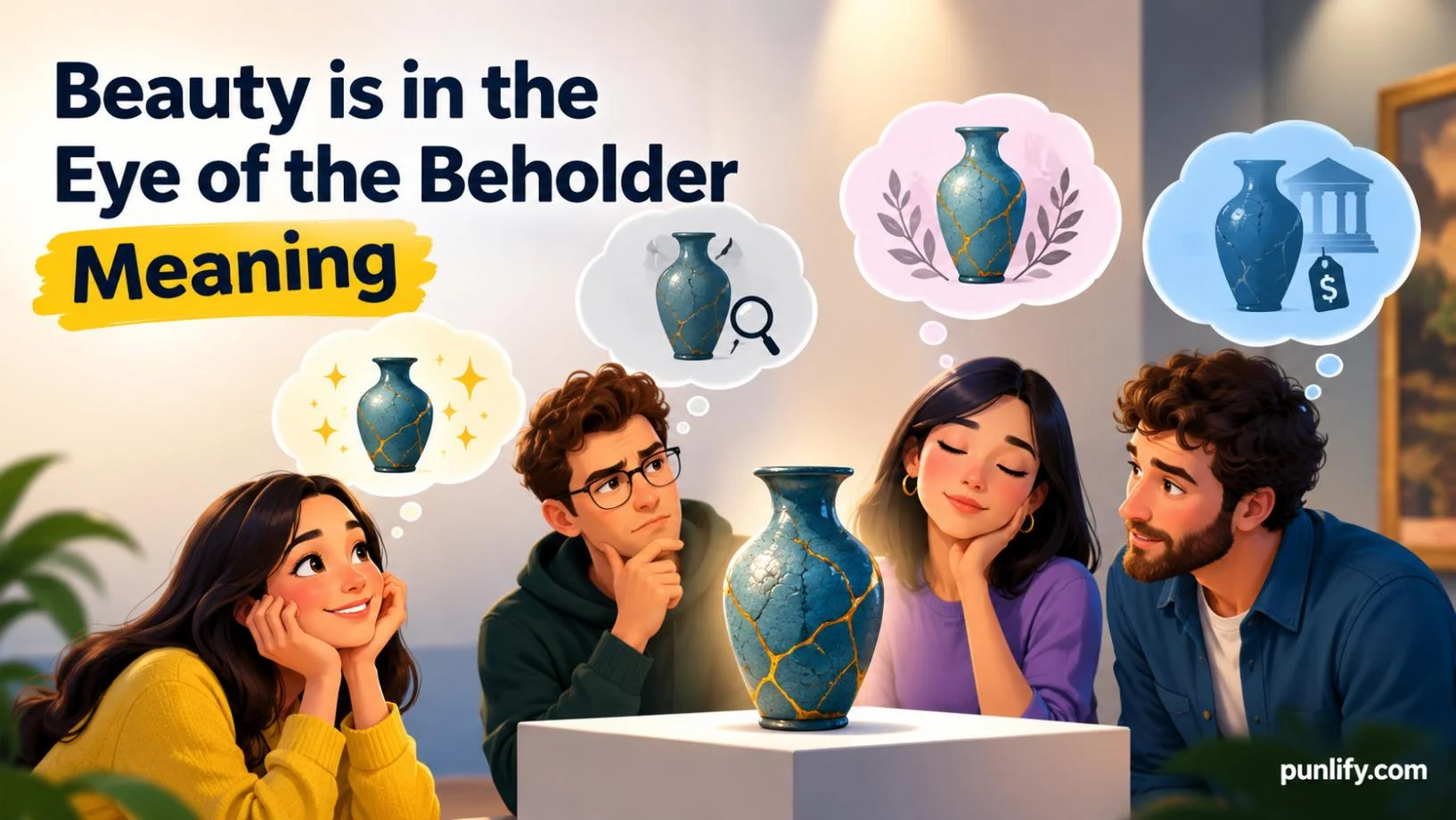
Think about it this way: two people can look at the exact same painting, the same face, or the same landscape, and walk away with completely different opinions. Neither person is “wrong.” Beauty, in this sense, isn’t an objective fact like gravity or math — it’s shaped by the observer’s own experiences, culture, mood, and personal taste.
“Beauty is in the eye of the beholder” essentially teaches us that our perception creates our reality — and that’s a powerful, freeing idea. ✨
So when someone uses this phrase, they’re usually trying to say: don’t judge something (or someone) as universally beautiful or ugly, because that judgment depends entirely on who’s looking.
The Origin of the Phrase: A Journey Through History 📜

Many people assume beauty is in the eye of the beholder is a modern expression, but its roots actually go back much further than most of us realize.
Ancient Greek Beginnings
The earliest known trace of this idea appears in the writings of the ancient Greek historian Herodotus, who lived around the 5th century BCE. He suggested that different cultures had entirely different standards of what was considered attractive — an idea that was radical for its time, when many civilizations believed beauty was a fixed, almost divine trait.
Popularized in the 19th Century
The phrase as we know it today gained real traction in English literature during the 1800s. Irish novelist Margaret Wolfe Hungerford is widely credited with the modern wording in her 1878 novel Molly Bawn, where she wrote a version very close to the saying we use now. From that point forward, the expression spread rapidly through everyday conversation and became one of the most quoted idioms in the English language.
Why It Stuck Around
Unlike many old sayings that fade with time, this one has stayed relevant because it captures a truth that every generation rediscovers on its own: beauty is subjective, and no two people experience it in exactly the same way.
Why This Old Saying Still Matters Today 🌍
You might be wondering — why should a centuries-old phrase matter in a world of AI filters, Instagram trends, and viral beauty standards? Honestly, it matters more now than ever.
- 🌟 It challenges the idea that there’s a “perfect” look everyone should chase.
- 🌟 It reminds us that comparison-based sadness is often built on a false premise.
- 🌟 It empowers people to embrace their own unique features instead of hiding them.
- 🌟 It explains why trends in fashion, art, and attraction constantly shift.
In an age where beauty standards are pushed aggressively through advertising and social media algorithms, remembering that beauty is in the eye of the beholder can genuinely protect your mental health and self-esteem.
The Psychology Behind Subjective Beauty 🧠
Science actually backs up this old idiom in some surprisingly detailed ways. Psychologists have studied how humans perceive attractiveness for decades, and the findings consistently show that beauty perception is influenced by far more than just physical features.
Personal Experience Shapes Perception
Our brains don’t judge beauty in a vacuum. Past experiences, childhood memories, and emotional associations all play a role. If someone reminds you of a kind teacher or a beloved relative, your brain may unconsciously find them more appealing — even if their features don’t match “conventional” beauty standards.
Cultural Conditioning
What’s considered beautiful in one culture can be completely different in another. Certain body types, skin tones, or facial features that are celebrated in one part of the world may be viewed neutrally — or even unfavorably — somewhere else. This cultural variation is one of the strongest pieces of evidence that beauty isn’t universal.
The “Mere Exposure Effect”

Psychologists have identified something called the mere exposure effect, where people tend to develop a preference for things simply because they’re familiar with them. This means the more you’re exposed to a certain look, style, or face, the more attractive it may start to seem to you over time — again proving beauty is a perception, not a fixed fact.
| Factor | How It Influences Beauty Perception |
|---|---|
| Culture | Different societies value different features as attractive |
| Personal Memories | Positive associations increase perceived attractiveness |
| Familiarity | Repeated exposure can make something seem more appealing |
| Mood & Emotion | Your emotional state at the moment affects your judgment |
| Media Influence | Advertising and social media shape short-term trends |
Real-Life Examples of “Beauty Is in the Eye of the Beholder” 💡
Let’s bring this idea down to earth with some real, relatable examples that show exactly how this phrase plays out in everyday life.
Example 1: Art and Fine Paintings
Walk into any art museum and you’ll notice something interesting — visitors linger at different paintings for completely different reasons. One person might be captivated by a chaotic abstract piece, while another finds it confusing and prefers a calm, realistic landscape instead. Neither reaction is incorrect; it’s simply beauty is in the eye of the beholder in action.
Example 2: Fashion Trends Across Decades
Think about how fashion has changed over the last 50 years. Bell-bottoms, shoulder pads, skinny jeans, oversized hoodies — styles once considered stunning became outdated, only to circle back into style again later. This constant cycle proves that beauty standards are temporary and shaped by the moment, not fixed truths.
Example 3: Personal Relationships
Ever noticed how a person can seem more and more attractive to you the better you know them, even if your first impression was neutral? This happens all the time in real relationships. As emotional connection deepens, perception of beauty often shifts along with it.
Example 4: Global Beauty Standards
In some cultures, fuller figures are historically celebrated as a sign of health and prosperity. In others, slimmer body types have been idealized. Neither standard is objectively “correct” — they’re culturally constructed preferences, which is exactly what the phrase is describing.
Beauty Is Subjective: Common Misunderstandings ⚠️
While most people use this phrase correctly, there are a few common misunderstandings worth clearing up.
Misunderstanding 1: “It Means Nothing Is Ever Truly Beautiful”
This isn’t accurate. The phrase doesn’t deny that beauty exists — it simply says that the judgment of what counts as beautiful varies from person to person.
Misunderstanding 2: “It Only Applies to Physical Appearance”
Many people assume this saying is only about faces or bodies, but it actually applies to almost everything — music, art, nature, architecture, even ideas. Anything that can be judged as “beautiful” is subject to personal interpretation.
Misunderstanding 3: “It’s Just a Nice Way to Comfort People”
While the phrase is often used to comfort someone who feels insecure, it’s not just a comforting cliché — it’s actually rooted in real psychological and historical evidence, as we covered earlier.
How to Apply This Wisdom in Everyday Life ✅
Understanding the meaning of beauty is in the eye of the beholder is one thing — actually applying it to your daily life is where the real transformation happens.
- 💖 Stop comparing your appearance to unrealistic online standards.
- 💖 Celebrate features that make you unique instead of hiding them.
- 💖 Remember that someone’s “type” or preference doesn’t define universal beauty.
- 💖 Teach children early that beauty comes in countless different forms.
- 💖 Appreciate art, people, and nature without needing external validation.
When you truly internalize that beauty is in the eye of the beholder, you stop chasing an impossible, ever-shifting standard — and start appreciating what’s genuinely in front of you.
Beauty Is in the Eye of the Beholder in Pop Culture 🎬
This phrase has appeared everywhere — from classic literature to modern movies, songs, and even advertising campaigns. Writers and filmmakers love using it because it instantly communicates a universal truth in just a handful of words. It’s often used in stories about self-acceptance, unlikely romances, or characters who are misunderstood because of their appearance, reinforcing the same timeless lesson: true beauty isn’t about fitting a mold.
Similar Sayings and Idioms Around the World 🌐
Interestingly, many cultures have their own version of this idea, which shows just how universal the concept really is, even if the exact wording differs.
- 🗣️ “There’s no accounting for taste” — a Western expression with a similar underlying message.
- 🗣️ Various folk sayings across Asian, African, and Latin American cultures echo the same idea: preferences vary from person to person.
- 🗣️ Philosophers throughout history, from ancient Greece to modern times, have debated whether beauty is objective or subjective — and the subjective side of that debate is essentially what this phrase represents.
Why Understanding This Phrase Boosts Self-Confidence 💪
One of the most powerful, practical benefits of truly understanding that beauty is in the eye of the beholder is the impact it can have on your self-esteem. So many people spend years feeling insecure about a feature — a nose shape, skin tone, height, or body type — simply because it doesn’t match a narrow, trending standard.
But once you genuinely grasp that beauty standards are subjective, shifting, and culturally constructed, it becomes much easier to let go of that pressure. Someone out there finds your exact features stunning — because beauty was never a single fixed target to hit in the first place.
Beauty Is in the Eye of the Beholder: A Quick Summary Table 📊
| Aspect | Explanation |
|---|---|
| Meaning | Beauty depends on the individual observer, not a fixed standard |
| Origin | Traces back to ancient Greece, popularized in 19th-century literature |
| Psychology | Supported by studies on culture, familiarity, and personal experience |
| Modern Relevance | Helps counter unrealistic social media beauty standards |
| Practical Use | Encourages self-acceptance and open-mindedness toward others |
FAQs:❓
1. What does “beauty is in the eye of the beholder” mean in simple words?
It simply means that what one person finds beautiful, another might not — beauty depends on who is looking, not on a fixed universal standard.
2. Where did the phrase “beauty is in the eye of the beholder” originate?
The concept dates back to ancient Greek writings, but the modern wording became popular through 19th-century English literature.
3. Is beauty really subjective, or is there scientific proof?
Yes, multiple psychological studies confirm that perceptions of beauty are shaped by culture, personal experience, familiarity, and emotional context, supporting the idea that beauty is subjective.
4. How can this phrase help with self-confidence?
Understanding that beauty standards are personal and ever-changing can help people stop comparing themselves to unrealistic ideals and start embracing their unique features.
5. Does “beauty is in the eye of the beholder” only apply to physical appearance?
No, it applies broadly — to art, music, nature, and even ideas. Anything that can be judged as beautiful is open to personal interpretation.
Final Thoughts:
At the end of the day, beauty is in the eye of the beholder isn’t just a pretty old saying — it’s a genuinely useful reminder that no single standard can define something as personal and varied as beauty. Whether you’re looking at a painting, a person, or your own reflection in the mirror, remember that your perception is valid, and so is everyone else’s.
Instead of chasing trends or comparing yourself to filtered images online, try appreciating the beauty that’s authentically yours. Because somewhere, to someone, it’s already stunning. 🌸

Ethan Parker is a dedicated content writer at Punlify.com, passionate about making language simple, clear, and easy to understand. He creates engaging, accurate, and reader-friendly content that helps people quickly understand modern words, phrases, slang, and everyday expressions.





One Comment