Adopt Meaning: Clever Guide to a Heartwarming Choice
Have you ever stumbled across the word “adopt” and paused for a second, wondering exactly what it means in this particular sentence? 🤔 You’re not alone. Whether you heard it while watching a heartwarming documentary about a family bringing home a rescue dog, read it in a business report about a company that decided to “adopt” new software, or came across it in a legal document about child custody — the word shows up everywhere, and its meaning shifts slightly depending on where you find it.
In this guide, we’re going to break down the complete adopt meaning in plain, simple English. No confusing jargon, no dictionary-speak that makes your eyes glaze over. Just a friendly, honest explanation that actually helps you understand and use this word with total confidence. 💬
By the end of this article, you’ll know the adopt meaning in every context it appears: parenting, pets, business, technology, law, and even everyday casual conversation. Let’s dive in! 🚀
📖 Adopt Meaning: The Simple Definition
At its core, the adopt meaning centers around one simple idea: taking something (or someone) as your own, on purpose, by choice. It’s an action word (a verb) that describes a deliberate decision to accept, embrace, or take responsibility for something that wasn’t originally “yours.”
Here’s the textbook version of the adopt meaning:
“To adopt” means to legally take another person’s child and bring them up as your own, or, more broadly, to choose to take up, follow, or start using an idea, method, style, or practice.
Notice how that definition actually covers two very different situations? That’s the beauty (and occasional confusion) of this word. The adopt meaning isn’t limited to just one scenario — it stretches across human relationships, animals, ideas, habits, and even technology. 🌍
Quick Snapshot Table: Adopt Meaning at a Glance
| Context | Adopt Meaning | Example |
|---|---|---|
| Parenting | Legally becoming a child’s parent | They adopted a baby girl from Vietnam. |
| Pets | Taking a rescue animal home permanently | We adopted a shelter dog last weekend. 🐶 |
| Business | Accepting and using a new system or policy | The company adopted a remote-work policy. |
| Technology | Starting to use a new tool or platform | Millions of users adopted the new app quickly. 📱 |
| Ideas/Habits | Choosing to follow a belief or lifestyle | She adopted a healthier morning routine. |
Already, you can see how flexible the adopt meaning truly is. It’s one of those words that quietly works overtime in the English language. 💪
🏛 The Origin and History Behind the Word “Adopt”
Understanding where a word comes from often makes its meaning stick better in your memory. So let’s take a quick trip back in time. ⏳
The word “adopt” traces back to the Latin word “adoptare”, which is a combination of “ad-” (meaning “to” or “toward”) and “optare” (meaning “to choose” or “to wish”). Put those together, and you basically get “to choose toward” — or more naturally, “to choose for oneself.”
This root gives us a beautiful insight into the true adopt meaning: it has always been about intentional choice. Nobody accidentally adopts a child, a pet, or a new habit. Adoption — in any form — requires a conscious decision. That’s part of what makes the word so emotionally powerful. 💛
The word made its way into Old French as “adopter” before entering English in the 15th century, originally used almost exclusively in the legal sense of taking a child as one’s own. Over centuries, English speakers naturally stretched its use to cover ideas, customs, technologies, and practices — which is exactly how we use it today.
👨👩👧 Adopt Meaning in the Context of Family and Parenting
This is probably the most well-known and emotionally rich use of the word. When people talk about the adopt meaning in family life, they’re almost always referring to the legal and emotional process of becoming a parent to a child who was born to someone else.
Here’s what adoption in this sense typically includes:
- 🧾 A legal process involving courts, paperwork, and background checks
- ❤️ A lifelong emotional commitment to raise the child as your own
- 👪 Full parental rights and responsibilities, identical to biological parenting
- 🌟 The child legally becomes part of the family, often taking the family’s last name
There are several different types of adoption, and understanding each one helps clarify the full scope of the adopt meaning in this context:
Types of Child Adoption
| Type | Description |
|---|---|
| Domestic Adoption | Adopting a child born within the same country |
| International Adoption | Adopting a child from a different country |
| Foster Care Adoption | Adopting a child who was previously in the foster system |
| Stepparent Adoption | A stepparent legally adopting their spouse’s child |
| Relative/Kinship Adoption | A family member (grandparent, aunt, uncle) adopting a related child |
No matter which type it is, the emotional core of the adopt meaning stays the same: choosing to love and raise a child as your own, no biology required. 🤍
🐾 Adopt Meaning When It Comes to Pets and Animals
If you’ve ever visited an animal shelter, you’ve probably seen the phrase “Adopt, Don’t Shop” plastered across posters and social media campaigns. This is one of the most heartwarming everyday uses of the word.
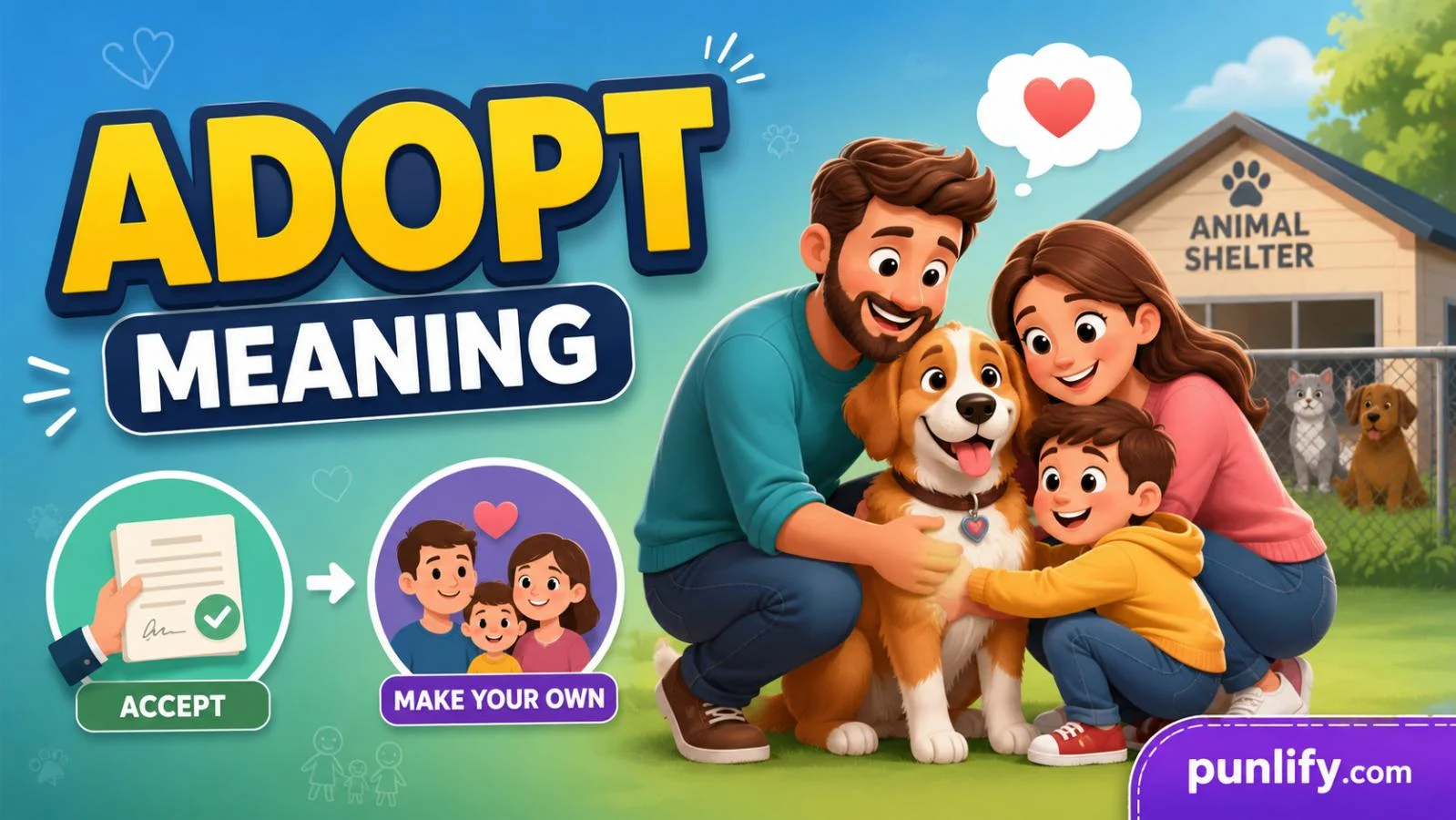
In this context, the adopt meaning refers to taking in an animal — usually a rescue or shelter animal — and giving it a permanent, loving home. Unlike buying a pet from a breeder, adopting typically means:
- 🏠 Giving a home to an animal that needs one
- 💰 Paying a smaller adoption fee rather than a purchase price
- 📋 Signing an adoption agreement or contract
- 🩺 Committing to the animal’s ongoing care, health, and wellbeing
Here’s a simple example sentence: “After months of searching, Sarah finally adopted a three-year-old tabby cat from her local shelter.” Notice how the adopt meaning here carries the same emotional weight as adopting a child — it’s about commitment, care, and choice. 🐱
💼 Adopt Meaning in Business and Professional Settings
Step outside the world of family and pets, and you’ll find the adopt meaning showing up constantly in business conversations. In this setting, “adopt” doesn’t involve people or animals at all — it involves ideas, systems, policies, and strategies.
When a company “adopts” something, it means they’ve officially decided to start using or following it. Some common examples include:
- 📊 A company adopts a new accounting method
- 🌱 A business adopts sustainable packaging practices
- 💻 An organization adopts cloud-based software
- 📜 A board adopts a new company policy
Here, the adopt meaning is really about official acceptance and implementation. There’s usually a formal decision-making process involved — a vote, a meeting, or leadership approval — before something gets “adopted” at a company level.
Why Businesses Care About “Adoption Rates”
You’ll often hear the term “user adoption” or “adoption rate” in the business and tech world. This refers to how quickly and widely people start using a new product, tool, or service. A high adoption rate means people are eagerly embracing the change — a low one means they’re resistant or slow to accept it. 📉📈
💻 Adopt Meaning in Technology and Innovation
Speaking of tech — this is another huge area where the adopt meaning plays a starring role. Every time a new app, gadget, or platform launches, tech writers and analysts talk about “adoption” constantly.
In this context, to adopt technology means to begin using it regularly, integrating it into your daily workflow or lifestyle. For example:
- 🤖 “Millions of people adopted AI tools within the first year of launch.”
- 📱 “Smartphone adoption skyrocketed in the early 2010s.”
- 🔋 “Electric vehicle adoption is growing steadily worldwide.”
There’s actually a well-known concept in marketing called the Technology Adoption Curve, which categorizes people based on how quickly they adopt new tech:
| Adopter Type | Description |
|---|---|
| Innovators | The very first to try new tech, love taking risks |
| Early Adopters | Quick to embrace new tools, influence others |
| Early Majority | Wait for proof before adopting |
| Late Majority | Skeptical, adopt only when it becomes the norm |
| Laggards | Resist change the longest, adopt last (if ever) |
Understanding this curve gives you an even richer picture of the adopt meaning in modern innovation — it’s not just about using something new, it’s about when and why people choose to embrace it. ⚙️
🧠 Adopt Meaning in Personal Habits, Ideas, and Beliefs
Beyond family, pets, business, and tech, the word “adopt” also shows up in deeply personal contexts. This is where the adopt meaning gets a little more abstract — but no less powerful.
When you “adopt” a habit, mindset, or belief, you’re consciously choosing to make it part of who you are. Some examples:
- 🧘 “He adopted a daily meditation practice to reduce stress.”
- 🥗 “She adopted a plant-based diet last year.”
- 📚 “The team adopted a growth mindset after the setback.”
- 🕊 “They adopted a more forgiving attitude toward mistakes.”
This everyday use proves just how versatile the adopt meaning really is. It applies whether you’re changing your morning routine or transforming your entire outlook on life. 🌤
⚖️ Adopt Meaning in Legal and Formal Language
Outside of child adoption specifically, the word “adopt” also appears in broader legal and governmental language. For example:
- 🏛 “The senate adopted the new resolution.”
- 📄 “The committee adopted the proposed amendment.”
- 🌐 “The country adopted a new constitution.”
In these formal settings, the adopt meaning refers to the official acceptance of a law, rule, resolution, or document through a structured, often ceremonial, process. It’s one of the more serious and weighty applications of the word.
🔤 Adopt vs. Adapt: Don’t Get These Confused!
Here’s a mix-up that trips up even native English speakers. “Adopt” and “adapt” look and sound almost identical, but they mean completely different things.
| Word | Meaning | Example |
|---|---|---|
| Adopt | To take something on as your own / start using | They adopted a new marketing strategy. |
| Adapt | To adjust or change to fit new conditions | They adapted the strategy to fit the new market. |
Remember it this way: you adopt something new, and then you might have to adapt to it. Keeping the true adopt meaning separate from “adapt” will instantly make your writing sound more polished and professional. ✍️
🔄 Common Synonyms for “Adopt”
Want to add more variety to your vocabulary? Here are some common synonyms that carry a similar tone to the adopt meaning, depending on context:
- Embrace – to accept enthusiastically
- Take on – to accept responsibility for something
- Assume – to take up a role or responsibility
- Foster – often used specifically for temporary child or animal care
- Implement – common in business/technology contexts
- Take up – to begin doing or using something
While these words are close in meaning, none of them capture the exact nuance of “adopt” in every situation — which is exactly why this word remains so widely used across the English language. 🗣
📝 How to Use “Adopt” Correctly in a Sentence
Let’s make sure the adopt meaning really sticks by looking at a variety of correct sentence examples across different contexts:
- “We officially adopted our son last spring.” 👶
- “The shelter helped us adopt a senior dog.” 🐕
- “The startup adopted an agile workflow.” 💼
- “Schools across the country adopted the new curriculum.” 🏫
- “I’ve adopted a more positive mindset this year.” 🌞
- “The city council adopted the new zoning law.” 🏙
Notice a pattern? In every single sentence, someone (a person, group, or organization) is making a deliberate choice to take something on. That consistency is the heartbeat of the true adopt meaning. 💓
🌟 Why Understanding “Adopt Meaning” Matters
You might be wondering — why does it even matter to fully understand the adopt meaning? Here’s why this small word carries big importance:
- 📚 It improves your reading comprehension across news, legal documents, and business reports
- ✍️ It sharpens your writing accuracy, especially in professional or academic settings
- 💬 It helps you communicate more clearly in everyday conversations
- 🌍 It connects you to meaningful topics like family, animal welfare, and innovation
Language shapes how we understand the world, and knowing the full adopt meaning gives you one more tool to express yourself precisely and confidently. 🗝
❤️ The Emotional Side of “Adopt”
It’s worth pausing here to acknowledge something important: unlike a lot of ordinary verbs, “adopt” often carries real emotional weight. Think about it — adopting a child changes an entire family’s story forever. Adopting a rescue animal can save a life. Even adopting a new mindset can transform how someone experiences their day-to-day life. 🌈
This is part of why the adopt meaning resonates so deeply with people. It’s not just a dry definition sitting in a dictionary — it represents choice, commitment, and often, love. 💫
FAQs:
1. What is the simplest adopt meaning?
The simplest adopt meaning is “to choose to take something as your own,” whether that’s a child, a pet, an idea, or a new practice.
2. Is “adopt” only used for children?
No! While child adoption is the most emotionally recognized use, the adopt meaning also applies to pets, business policies, technology, habits, and legal decisions.
3. What’s the difference between “adopt” and “adapt”?
“Adopt” means to take on or start using something new, while “adapt” means to adjust or change to fit new circumstances. They sound alike but mean very different things.
4. Can you “adopt” an idea or belief?
Yes, absolutely. People commonly adopt mindsets, habits, and beliefs, such as adopting a healthier lifestyle or a more optimistic outlook.
5. Where does the word “adopt” come from?
The word originates from the Latin term “adoptare,” meaning “to choose for oneself,” which entered English through Old French around the 15th century.
🎯 Final Thoughts:
So, there you have it a complete, friendly, and thorough breakdown of the adopt meaning across every major context: family, pets, business, technology, personal growth, and formal law. What started as a simple word rooted in the Latin idea of “choosing for oneself” has grown into one of the most emotionally rich and versatile verbs in the English language. 🌍
Whether you’re welcoming a child into your family, bringing home a rescue pup, implementing a new company policy, or simply adopting a healthier morning routine, the underlying spirit remains the same: intentional, meaningful choice. 💛

Ethan Parker is a dedicated content writer at Punlify.com, passionate about making language simple, clear, and easy to understand. He creates engaging, accurate, and reader-friendly content that helps people quickly understand modern words, phrases, slang, and everyday expressions.