
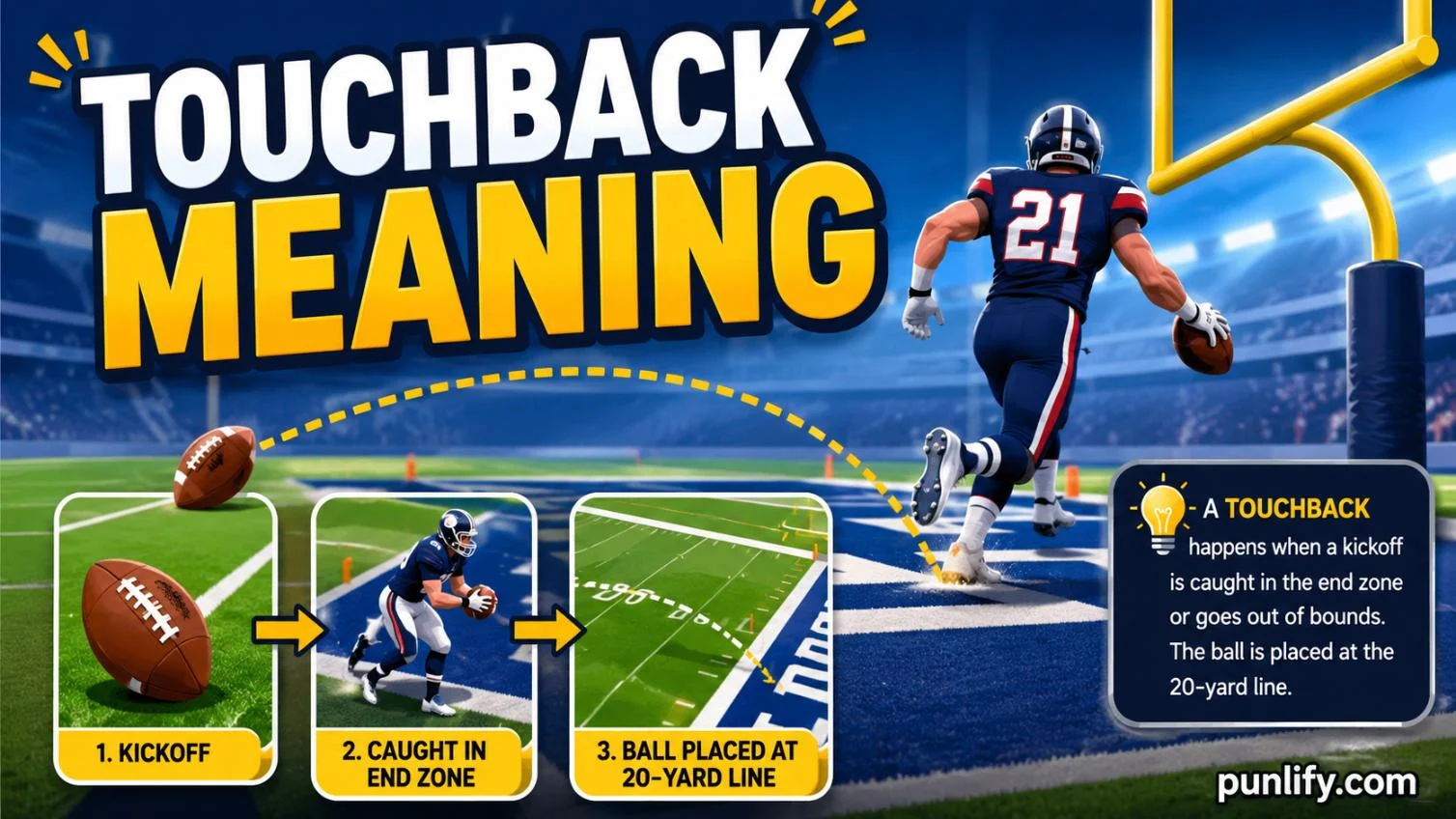
Touchback Meaning: The Ultimate Easy Football Guide
Picture this: it’s fourth quarter, the game is tight, and the kicker booms the ball deep into the end zone. The returner takes a knee instead of running it out. The crowd groans, the announcer says “that’s a touchback,” and casual fans everywhere reach for their phones to Google what just happened. Sound familiar? 😅 If you’ve ever felt that tiny flash of confusion during a big game, you’re definitely not alone.
Understanding the touchback meaning is one of those small but mighty pieces of football knowledge that instantly makes the game click. Once you know it, you’ll never squint at the scoreboard again. In this guide, we’ll break down the touchback meaning in plain, friendly language, walk through real examples, compare it with similar rules like safety, and even cover the freshest 2025 rule updates that changed how touchbacks work. Grab a snack, get comfy, and let’s dig in! 🍿
What Is the Touchback Meaning in Football? 🤔
At its core, the touchback meaning is simple: it’s a dead-ball ruling that happens when the ball becomes dead on or behind the goal line that a team is defending, and the opposing team is the one who caused it to get there. No points are scored, nobody celebrates, and the defending team simply gets to start their next drive from a specific yard line.
Think of it like a “reset button” 🔄. The ball crossed into dangerous territory, but instead of a touchdown or a safety, the play just… stops. The defense picks up the ball (metaphorically) and starts fresh.
“A touchback is one of football’s quiet rules — it doesn’t score points, but it quietly shapes field position and, often, the outcome of the entire game.”
So whenever someone asks, “what is a touchback?” — the short answer is: it’s a non-scoring play where the ball dies in the end zone because of the other team’s action, and possession flips to the defense at a set spot on the field.
Where Does the Word “Touchback” Come From? 📜
The term has a surprisingly literal origin. In early American football, when a player would touch the ball down behind their own goal line to stop play (rather than risk a fumble or a tackle that could lead to a safety), it was described as the ball being “touched back.” Over decades of rule evolution, this informal phrase became the official name for the modern play we know today.
Unlike flashy terms like “Hail Mary” or “pick-six,” the touchback meaning stayed close to its roots — it’s still, quite literally, about the ball being touched (or landing) behind the line and staying dead there. Simple name, simple concept, but big strategic impact. 🎯
The Official Rulebook Definition (Made Simple) 📘
Football rulebooks love complicated language, but here’s the plain-English version. According to the official rules, it’s a touchback if:
- The ball becomes dead on or behind the goal line a team is defending
- The impetus (the force that sent the ball there) came from the opposing team
- The play does not result in a touchdown or an incomplete pass
That word “impetus” trips a lot of people up, but it just means “who caused the ball to go there.” If the offense’s own player carries the ball into their own end zone and it’s downed there because of a bad snap or their own fumble recovery, that’s usually a safety, not a touchback — because their own team supplied the force. But if a kicker or punter sends the ball deep and it dies in the end zone, that’s the opposing team’s impetus, and the touchback meaning applies. 🙌
Touchback vs. Safety: What’s the Real Difference? ⚖️
This is probably the single most confusing comparison in football rules, so let’s clear it up once and for all with a simple table.
| Feature | Touchback 🏳️ | Safety 🚨 |
|---|---|---|
| Who caused the ball to enter the end zone | The opposing team (kick, punt, interception) | The team defending that end zone (own fumble, sack, etc.) |
| Points scored | Zero | Two points for the defense |
| Who gets possession next | The team defending the end zone | The team that just scored the safety (via free kick) |
| Emotional impact | Neutral — just a field-position reset | Huge — a scoring play and a momentum shift |
So remember: if you caused your own trouble, it’s a safety and you lose two points. If the other team’s kick or pass ends up dead in your end zone, it’s simply a touchback, and you get to start driving from a favorable spot. Understanding this difference is a huge part of really grasping the touchback meaning in real game situations.
Where Does the Ball Get Placed After a Touchback? 📍
This is where things get genuinely interesting, especially with recent rule changes. The exact yard line depends on how the touchback happened. Here’s a breakdown for the current NFL rules.
Kickoff Touchbacks (Updated 2024–2025 Rules)
| Scenario | Ball Spotted At |
|---|---|
| Kick enters the end zone on the fly and is downed | 35-yard line |
| Kick sails completely out the back of the end zone | 35-yard line |
| Kick first touches the “landing zone” then bounces into the end zone and is downed | 20-yard line |
This is a big deal! Under the newer “Dynamic Kickoff” format, the NFL wanted to reward returners for actually attempting returns rather than always taking a touchback, so they created two different outcomes depending on exactly where and how the ball lands. It’s a clever twist on the classic touchback meaning, and it rewards teams that field kicks strategically. ⚡
Punt, Interception, and Fumble Touchbacks
For most other situations — like a punt that rolls dead in the end zone, an interception returned into your own end zone and downed, or a fumble recovered by the defense in the end zone — the standard spot remains the 20-yard line. This has stayed fairly consistent for decades and is the “classic” version most fans grew up learning.
College Football (NCAA) Rules
College football uses a slightly different standard. Kickoff touchbacks and free kicks after a safety are placed at the 25-yard line, which has been the standard since 2012. This is one of the small but important differences between NFL and college rule books that fans should keep in mind.
Real-Life Examples of a Touchback in Action 🎬
Sometimes rules make more sense with a story. Let’s walk through a few classic scenarios.
- Example 1 — The Deep Kickoff: A kicker blasts the ball five yards deep into the end zone. The returner sees no lane and simply takes a knee. Result: touchback, ball placed at the 35-yard line under current rules.
- Example 2 — The Bouncing Punt: A punter’s kick lands at the 3-yard line and rolls into the end zone before the coverage team can down it near the goal line. The receiving team lets it die in the end zone. Result: touchback at the 20-yard line, saving the offense from starting inside the 5.
- Example 3 — The End Zone Interception: A quarterback throws deep into the end zone; a safety intercepts the pass and, seeing no room to run, kneels immediately. Result: touchback, offense (formerly the defense) now starts at the 20-yard line.
Every one of these situations shares the same DNA: the opposing team caused the ball to arrive in the end zone, and the play died there without a score. That consistent thread is really the heart of the touchback meaning across every situation in the sport.
Why Touchbacks Matter Strategically 🧠
You might be thinking, “okay, it’s just a rule — why should I care?” Here’s why coaches obsess over it:
- Field position is everything. Starting a drive at your own 35 versus your own 8 is a massive difference in scoring probability.
- It shapes special teams strategy. Kickers now aim for specific “landing zones” instead of just blasting the ball as far as possible, because of how the modern touchback rules reward or punish different outcomes.
- It affects late-game decisions. A team protecting a lead might intentionally kick short to pin the opponent deep rather than risk a long return, even if it means giving up a touchback at a better yard line.
So while a touchback might look like “nothing happened,” in reality, it’s a quiet but powerful chess move that shifts the entire complexion of a game. ♟️
Touchback Rules Beyond the NFL 🌍
The touchback meaning isn’t exclusive to the NFL. Different leagues and levels of football apply their own small variations:
- High School Football: Touchbacks are generally spotted at the 20-yard line, following the more traditional rule structure.
- College Football (NCAA): Kickoff touchbacks go to the 25-yard line, and fair catches inside the 25 on a kickoff are also treated as touchbacks.
- Canadian Football (CFL): Touchback rules exist too, though the CFL’s larger field and different kickoff structure change how often they occur.
No matter the league, the underlying idea stays the same: a non-scoring dead ball in the end zone, caused by the opposing team, that resets possession at a set spot.
Common Myths About Touchbacks ❌
Let’s clear up a few misunderstandings that trip up even long-time fans.
Myth 1: “A touchback is the same as a touchdown.”
Not even close! A touchdown scores six points. A touchback scores zero points and simply resets field position. The similar-sounding names are honestly one of the most confusing things in football terminology.
Myth 2: “Touchbacks always happen at the 20-yard line.”
This used to be more true, but modern rules (especially the newer kickoff system) mean the spot can be the 20, 25, or 35-yard line depending on the exact situation, as we covered in the table above.
Myth 3: “A returner has to take a knee for it to count.”
Not exactly — a touchback can also happen if the ball simply goes out of the back of the end zone, or if a defensive player recovers a loose ball there and it’s ruled dead, even without a formal kneel-down.
How to Explain the Touchback Meaning to a Beginner 👶
If a friend or family member new to football asks you to explain it, here’s a foolproof, one-sentence answer you can use:
“A touchback means the other team kicked or threw the ball into our end zone, we didn’t score anything, and now we just start our next play from a set yard line instead of way back at the goal line.”
Short, clear, and memorable. That’s really all the touchback meaning boils down to once you strip away the jargon. 😊
A Quick Step-by-Step: How a Touchback Unfolds 🎥
- Step 1: A kick, punt, or turnover sends the ball toward or into the end zone.
- Step 2: The ball becomes dead there — either through a kneel-down, going out of bounds, or being downed.
- Step 3: The officials confirm the opposing team caused the ball’s path (the “impetus”).
- Step 4: No touchdown, no safety — it’s ruled a touchback.
- Step 5: The ball is spotted at the appropriate yard line (20, 25, or 35, depending on the play type and league).
- Step 6: The offense begins their drive from that spot.
Once you see it broken down step by step, the touchback meaning feels almost obvious — it’s really just a structured way of handling “the ball ended up somewhere without anyone scoring.”
Touchbacks and Fantasy Football: Does It Matter? 🏆
For fantasy football players, touchbacks themselves don’t directly generate stats — no yards, no points. However, they indirectly matter a lot! A kicker who consistently forces touchbacks pins opponents deep, which can lead to more punts, more short fields for your fantasy quarterback, and better overall offensive opportunities. Savvy fantasy managers pay attention to which kickers and punters are touchback machines, since it hints at overall team strategy and field-position advantages. 📊
Quick-Reference Touchback Cheat Sheet 🗒️
| Situation | Result | Yard Line |
|---|---|---|
| Kickoff caught in end zone, downed on fly | Touchback | 35 (NFL) |
| Kickoff bounces in landing zone into end zone, downed | Touchback | 20 (NFL) |
| Punt dead in end zone | Touchback | 20 |
| Interception downed in end zone | Touchback | 20 |
| College kickoff touchback | Touchback | 25 (NCAA) |
Bookmark this table! It’s a handy shortcut whenever you forget exactly where the ball should be spotted after a touchback during a game. 📌
FAQs:
Q1: What is the simplest touchback meaning for a beginner?
It’s when the ball dies in the end zone because of the other team’s kick, punt, or turnover, resulting in zero points and a fresh drive from a set yard line.
Q2: Is a touchback good or bad for the offense?
It depends on perspective! For the team that just kicked or threw the ball, a touchback is mildly disappointing because it means good field position for the opponent. For the team receiving the touchback, it’s a nice, safe way to start a drive without risk of a fumble on a return.
Q3: Can a touchback happen on a fumble?
Yes. If a player from the opposing team causes a fumble that rolls into the end zone and the defending team recovers or downs it there, it’s ruled a touchback rather than a safety, since the impetus came from the opponent.
Q4: Why did the NFL change the touchback yard line?
The league wanted to encourage more exciting returns instead of automatic knee-downs, so it adjusted the reward system — spotting fly-ball touchbacks at the 35 while keeping bounced ones at the 20, nudging teams to actually attempt returns.
Q5: Does a touchback count as a turnover?
Not in the traditional sense of an interception or fumble recovery stat, but possession does change hands to the receiving team, so functionally, yes — the ball transfers from one team’s control to the other.
Final Thoughts:💡
At the end of the day, understanding the touchback meaning transforms how you watch football. What once felt like a random, uneventful stoppage now reveals itself as a strategic decision point loaded with implications for field position, momentum, and game planning. Whether it’s a booming kickoff, a well-placed punt, or a smart end zone interception, every touchback tells a small story about strategy and situational awareness.
Next time you’re watching a game and hear the announcer call a touchback, you’ll know exactly what happened, why it happened, and why it matters. That’s the kind of knowledge that turns a casual viewer into a genuinely informed fan. 🙌

Ethan Parker is a dedicated content writer at Punlify.com, passionate about making language simple, clear, and easy to understand. He creates engaging, accurate, and reader-friendly content that helps people quickly understand modern words, phrases, slang, and everyday expressions.






One Comment