
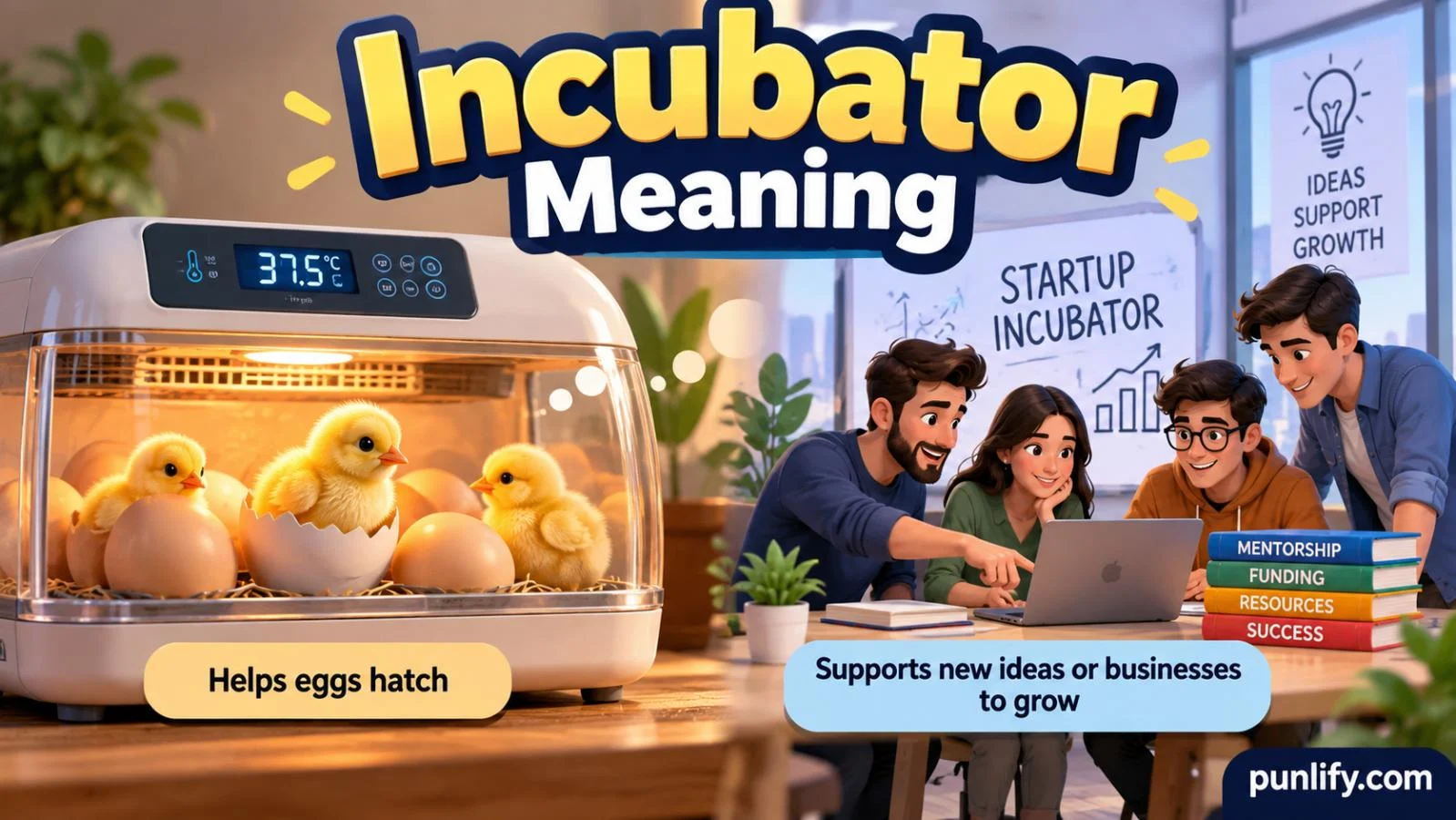
Incubator Meaning: A Helpful Guide to the Real Meaning
Have you ever heard someone say, “My startup came out of an incubator,” and wondered what on earth that actually meant? 🤔 Or maybe you stumbled on the word while reading about hospitals, hatching eggs, or science labs, and now your brain is juggling three completely different pictures. You’re not alone. The incubator meaning shifts depending on where you hear it, and that’s exactly why so many people search for a simple, honest explanation.
Here’s the truth: at its core, the incubator meaning always circles back to one beautiful idea — creating a safe, controlled space where something fragile can grow into something strong. Whether it’s a business idea, a chicken egg, a premature baby, or bacteria in a petri dish, an incubator is a protective environment designed to nurture growth until the thing inside is ready to survive on its own. 🌱
In this guide, we’re going to unpack the incubator meaning from every angle — the word’s origin, its use in business, science, agriculture, and healthcare, real-world examples, and even a few personal insights that most articles skip. By the end, you won’t just know the dictionary definition. You’ll actually understand it. Let’s dive in! 🚀
📖 What Is the Incubator Meaning? A Simple Definition
Let’s start with the basics. In the simplest terms, the incubator meaning refers to a device, organization, or environment that provides ideal conditions for growth, development, or survival of something that isn’t yet strong enough to thrive on its own.
Think of it like a greenhouse for plants — except instead of just sunlight and water, an incubator controls temperature, humidity, oxygen levels, funding, mentorship, or resources, depending on what’s being “incubated.”
“An incubator doesn’t create life or ideas. It simply gives them the best possible chance to survive their most fragile stage.” — a phrase often used by startup mentors and neonatal nurses alike.
So when someone asks, “What does incubator mean?” the honest answer is: it depends on the context — but the underlying purpose is always the same: protection, nurturing, and controlled growth.
🕰️ The Origin of the Word “Incubator“
Understanding the incubator meaning gets a lot easier once you know where the word came from. The term traces back to the Latin word “incubare,” which means “to lie upon” or “to sit on.” Ancient farmers noticed that hens would sit on their eggs to keep them warm, and this act of “sitting on” something to help it develop became the root of the modern word.
By the late 1800s, the word had evolved into its modern scientific and medical sense. French obstetrician Stéphane Tarnier is often credited with adapting poultry-incubation technology into the first practical infant incubators in the 1880s, dramatically improving survival rates for premature babies. From there, the concept expanded into laboratories, and eventually, by the mid-20th century, into business and technology.
So really, the incubator meaning has a beautifully consistent thread running through history: warmth, protection, and a controlled environment for something young or fragile. 🐣
🏢 Business Incubator Meaning: Helping Startups Grow
This is probably the most searched version of the term today, especially among entrepreneurs. A business incubator is an organization or program designed to support early-stage startups by providing resources like office space, mentorship, funding connections, legal help, and networking opportunities.
Startups are fragile in their early days — just like a chick in an egg. They need the right “temperature” (market conditions), the right “nutrients” (capital and mentorship), and protection from outside threats (competition, bad decisions, cash flow issues) until they’re strong enough to survive on their own.
🔑 Key Features of a Business Incubator
- Physical workspace — shared offices, meeting rooms, or co-working spaces
- Mentorship programs — guidance from experienced founders and industry experts
- Networking access — connections to investors, partners, and other startups
- Educational resources — workshops on marketing, finance, and operations
- Funding opportunities — sometimes direct investment, sometimes introductions to angel investors
Popular examples of business incubators include university-run programs, government-backed innovation hubs, and private corporate incubators. Unlike accelerators (which we’ll compare shortly), incubators usually don’t have a fixed timeline — a startup might stay “incubated” for months or even years until it’s ready to stand on its own.
📊 Business Incubator vs. Startup Accelerator

| Feature | Business Incubator | Startup Accelerator |
|---|---|---|
| Duration | Open-ended (months to years) | Fixed (usually 3–6 months) |
| Focus | Idea development and stability | Rapid growth and scaling |
| Funding | Optional, often indirect | Usually provided in exchange for equity |
| Stage of Startup | Very early or idea stage | Slightly more developed, ready to scale |
This comparison alone shows why understanding the incubator meaning in business is so important — mixing it up with “accelerator” can lead entrepreneurs to apply to the wrong program entirely.
🐣 Egg Incubator Meaning: Nature’s Original Model
Let’s go back to where it all started — poultry farming. An egg incubator is a machine designed to imitate the warmth and humidity a mother hen provides while sitting on her eggs. It regulates temperature (usually around 99.5°F or 37.5°C for chicken eggs), humidity levels, and even automatically turns the eggs to mimic natural nesting behavior.
This is honestly one of the clearest ways to explain the incubator meaning to someone who’s never heard the term before, because it’s so visual and intuitive. No warmth, no life. The incubator simply recreates what nature already does — just more consistently and at a larger scale for commercial farms.
🌡️ What an Egg Incubator Controls
- Temperature — kept stable to avoid developmental issues
- Humidity — essential for proper eggshell moisture and hatching success
- Ventilation — oxygen flow for the developing embryo
- Egg turning — prevents the embryo from sticking to the shell
Farmers and hobbyists alike use egg incubators to hatch chickens, ducks, quails, and even exotic birds. It’s a small, real-world example that perfectly captures the essence of the incubator meaning: controlled conditions that give something the best chance to survive its most vulnerable stage.
👶 Medical Incubator Meaning: Protecting Premature Babies
Perhaps the most emotionally powerful use of the word shows up in hospitals. A medical incubator, also called a neonatal incubator, is a clear, enclosed bed used to keep premature or fragile newborns warm, protected from infection, and monitored closely by medical staff.
This is where the incubator meaning takes on real weight. Premature babies often can’t regulate their own body temperature, fight off infections, or breathe as efficiently as full-term infants. An incubator recreates a womb-like environment — warm, humid, and shielded from external germs — giving these tiny fighters extra time to grow stronger. 💙
🏥 What a Neonatal Incubator Provides
- Stable body temperature control
- Humidity regulation to protect delicate skin
- Infection control through a semi-sealed environment
- Oxygen supply when needed
- Continuous monitoring of heart rate, oxygen levels, and breathing
Ever since Dr. Tarnier’s original design in the 1880s, neonatal incubators have saved millions of lives worldwide. Understanding this version of the incubator meaning often gives people a much deeper emotional appreciation for the word — it’s not just a business buzzword, it’s literally a life-saving invention.
🧪 Laboratory Incubator Meaning: The Scientist’s Best Friend
In science labs, a laboratory incubator is a piece of equipment used to grow and maintain microbiological cultures, cell cultures, or biological samples at a controlled temperature, humidity, and gas composition (like CO2 levels).
Researchers rely on lab incubators for everything from studying bacteria and viruses to developing vaccines and conducting genetic research. Without a stable environment, these delicate cultures simply wouldn’t survive long enough to be studied.
⚙️ Common Types of Laboratory Incubators
- CO2 incubators — used for cell culture growth
- Shaking incubators — used to grow bacterial cultures with constant agitation
- Cooled incubators — maintain lower temperatures for sensitive samples
- Vacuum incubators — used for drying and specialized sample prep
Once again, the incubator meaning in this context boils down to the same core idea: a controlled, protective environment that allows something small and fragile to develop into something scientifically useful.
💻 Tech Incubator Meaning: Nurturing Innovation
In the tech world, the term overlaps heavily with the business incubator concept, but it’s worth calling out separately because of how common it’s become in Silicon Valley culture. A tech incubator specifically supports technology-based startups — think software, apps, AI tools, and hardware innovations.
These incubators often provide specialized resources like cloud computing credits, access to developer tools, technical mentorship, and connections to venture capital firms that understand the tech landscape.
Some well-known examples of organizations that function as tech incubators include university innovation labs, corporate R&D incubation arms, and government-funded digital innovation hubs. The incubator meaning here is really about giving raw technical ideas the runway they need before they’re ready for the open market.
🌍 Why the Incubator Meaning Matters in Today’s World
You might be wondering — why does this word matter so much right now? Great question. Here’s the honest answer: we live in an era obsessed with growth, innovation, and giving fragile things a fighting chance, whether that’s a business idea, a scientific breakthrough, or a newborn baby.
Understanding the incubator meaning helps you:
- ✅ Choose the right program if you’re launching a startup
- ✅ Understand medical terminology if you or a loved one has a premature baby
- ✅ Make informed decisions if you’re getting into poultry farming
- ✅ Follow scientific research and lab-based news more confidently
- ✅ Communicate clearly in business, healthcare, or academic conversations
It’s a word that quietly shows up across so many parts of life, and knowing its full range of meaning genuinely makes you a sharper communicator. 🧠
🔍 Common Misconceptions About Incubator Meaning
Let’s clear up a few myths, because misunderstanding the incubator meaning can lead to confusion in real conversations.
❌ Myth 1: Incubators and Accelerators Are the Same Thing
As shown in the table earlier, they’re related but not identical. Incubators nurture early ideas over longer periods; accelerators push already-formed startups toward rapid growth in short bursts.
❌ Myth 2: Incubators Only Apply to Babies or Businesses
As we’ve seen, the incubator meaning spans agriculture, science, medicine, and technology — it’s far broader than most people assume.
❌ Myth 3: Incubators Guarantee Success
Whether it’s a startup, an egg, or a lab culture, an incubator only provides favorable conditions. It doesn’t guarantee survival or success — it simply improves the odds significantly.
🛠️ How to Choose the Right Incubator (Business Context)
If you’re an entrepreneur trying to understand the incubator meaning in a practical, actionable way, here are a few tips before applying to one:
📋 Checklist Before Joining a Business Incubator
- Research their track record — how many startups have they helped succeed?
- Understand the terms — do they take equity? What’s expected in return?
- Check the mentorship quality — are mentors actually experienced in your industry?
- Evaluate the network — will you gain access to useful investors and partners?
- Assess the resources — office space, tools, funding connections, etc.
Choosing the right incubator can genuinely shape the trajectory of a young business, so this decision deserves real thought rather than a rushed application.
🌱 Real-World Example: From Idea to Incubation
Let’s paint a quick, relatable picture. Imagine Sarah, a software developer with an idea for a budgeting app. On her own, she has the code but no funding, no mentorship, and no network of investors. She applies to a local business incubator.
Inside the incubator, she gets:
- A small office space to work from
- Weekly mentorship sessions with a fintech expert
- Introductions to two angel investors
- Access to legal advice for setting up her company
Six months later, Sarah’s app has real users, a small team, and seed funding. That’s the incubator meaning in action — not magic, just structured support during a fragile stage of growth.
🧩 Incubator Meaning: A Quick Comparison Across Fields
| Field | What’s Being “Incubated” | Main Purpose |
|---|---|---|
| Business | Startups and ideas | Mentorship, funding, growth support |
| Agriculture | Eggs | Stable warmth and humidity for hatching |
| Medicine | Premature newborns | Temperature control and infection protection |
| Science | Cell cultures, bacteria | Controlled growth conditions for research |
| Technology | Tech startups and innovations | Technical mentorship and resources |
This table alone sums up why the incubator meaning is one of those rare words that stays conceptually consistent while changing completely in application.
💬 What Experts Say About the Incubator Concept
“Incubation isn’t about doing the growing for someone — it’s about removing the obstacles that would otherwise stop growth from happening naturally.” — a common principle taught in entrepreneurship and neonatal care training programs alike.
This quote captures something important about the incubator meaning that a lot of definitions miss: incubators don’t force growth. They simply remove friction and provide stability, letting natural development take its course — whether that’s a business plan, a chick, or a human life.
❓FAQs:
1. What is the simplest incubator meaning?
In the simplest sense, an incubator is a controlled environment or program that supports the growth and protection of something fragile — whether that’s a business idea, an egg, a baby, or a lab sample.
2. Is a business incubator the same as a startup accelerator?
No. A business incubator typically supports startups over a longer, more flexible timeframe, while an accelerator focuses on rapid growth within a fixed short-term program.
3. How does an egg incubator work?
An egg incubator mimics a mother hen by controlling temperature, humidity, ventilation, and egg turning, creating ideal conditions for embryos to develop and hatch successfully.
4. Why do premature babies need incubators?
Premature babies often can’t regulate body temperature or fight infections effectively on their own, so medical incubators provide a warm, protected, monitored environment until they’re stronger.
5. Can the word “incubator” apply outside of business and biology?
Yes! While business, agriculture, medicine, and science are the most common contexts, the core incubator meaning — a nurturing, controlled environment for growth — can metaphorically apply to almost any developing idea, skill, or project.
🎯 Conclusion:
So, what’s the real takeaway here? The incubator meaning isn’t locked into one single definition it’s a flexible, powerful concept that shows up in hospitals, farms, laboratories, and startup offices around the world. At its heart, though, it always represents the same beautiful idea: giving something fragile the time, warmth, and support it needs to grow strong enough to stand on its own. 🌟
Whether you came here curious about business incubators, egg incubators, or medical incubators, we hope this guide gave you a clear, complete, and genuinely useful understanding of the word — one that goes far beyond a quick dictionary definition.

Ethan Parker is a dedicated content writer at Punlify.com, passionate about making language simple, clear, and easy to understand. He creates engaging, accurate, and reader-friendly content that helps people quickly understand modern words, phrases, slang, and everyday expressions.






One Comment