
Bread and Butter Meaning: A Clever Guide to Its Meaning🍞🧈
Have you ever heard someone say, “Teaching is my bread and butter,” and wondered what on earth toast has to do with their job? 😅 You’re not alone. This cozy little phrase shows up in offices, kitchens, novels, and everyday conversations, yet a surprising number of people still aren’t 100% sure of the real bread and butter meaning. If you’ve ever paused mid-conversation thinking, “Wait, are we talking about actual food right now?” — this article is for you.
By the end of this guide, you’ll understand the bread and butter meaning inside and out: where it came from, how it’s used today, and how to drop it into your own writing and speech like a native English speaker. Let’s dig in! 🍽️
What Does “Bread and Butter” Really Mean? 🤔
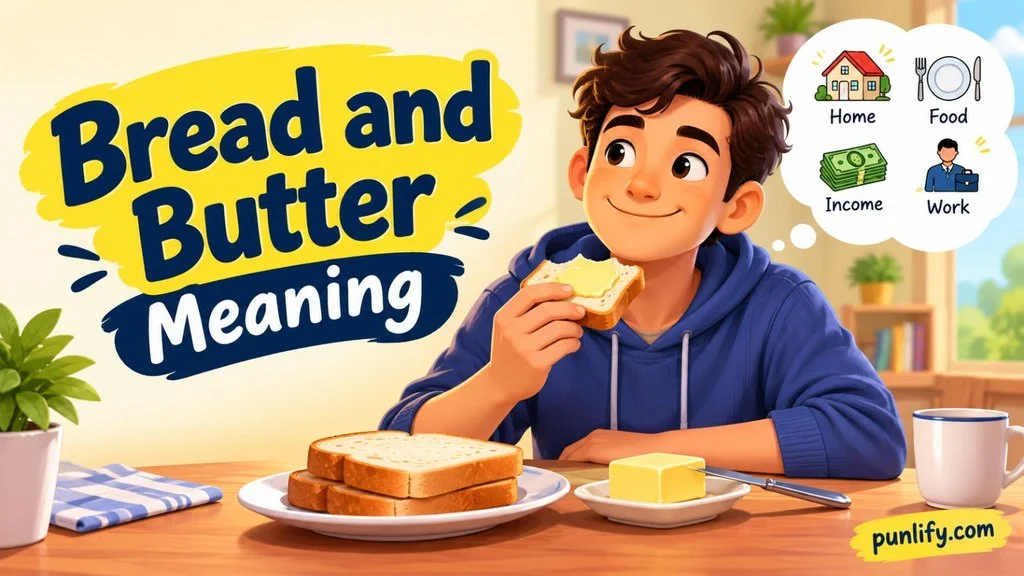
At its core, the bread and butter meaning refers to someone’s main source of income or the essential thing that keeps them going. It’s the basic, dependable foundation of a person’s livelihood — much like actual bread and butter used to be the basic, dependable food on a family’s table.
So when someone says, “Freelance writing is my bread and butter,” they simply mean it’s how they pay their bills. It’s their primary job, their steady income, their financial foundation. Simple, right? But there’s more nuance here than you might think.
The phrase can also describe:
- The core skill someone relies on most (e.g., “Defense is this team’s bread and butter”)
- The basic necessities of life
- Something fundamental or routine, without extra frills
In short, the bread and butter meaning always circles back to one idea: the essential, dependable thing that supports everything else.
The Literal Origin of Bread and Butter 🍞
Before it became a figure of speech, bread and butter was, quite literally, a staple food. For centuries in England and much of Europe, bread served with a spread of butter was considered a **basic, everyday meal** for ordinary families. It wasn’t fancy. It wasn’t a luxury. It was simply what people ate to survive.
Because bread and butter was so common and so essential to daily life, it naturally became a symbol of anything basic, dependable, and necessary. Over time, English speakers began using the phrase metaphorically to describe other essential things — especially income and livelihood.
This is actually a really common pattern in language. Food-related idioms often grow out of what people ate most often. Think about phrases like “the meat and potatoes of the issue” — same idea, different meal! 🥔
How “Bread and Butter” Became an Idiom 📖
Language historians trace the figurative use of this phrase back to at least the 18th century, when English writers began using “bread and butter” to represent one’s livelihood or daily sustenance. By the 1800s, the phrase was firmly established in everyday speech across Britain and, later, the United States.
Interestingly, the phrase also picked up a secondary, more playful use: children in the 19th and 20th centuries would say “bread and butter” as a little superstitious chant while walking around an obstacle (like a lamppost) with a friend, believing it would prevent bad luck from splitting their friendship. While that usage is mostly nostalgic today, it shows just how deeply this phrase settled into everyday culture.
By the time it reached modern English, the bread and butter meaning had firmly shifted toward describing someone’s primary livelihood or core skill — the sense we use most often today.
Bread and Butter Meaning in Modern English 💼
Today, when native English speakers use this idiom, they’re almost always talking about work, income, or something essential. Here’s a quick breakdown of how the modern bread and butter meaning shows up:
| Usage Context | What It Means | Example |
|---|---|---|
| Career/Income | Main source of income | “Consulting is my bread and butter.” |
| Business | Core product or service | “Loyal customers are our bread and butter.” |
| Sports | A player’s key skill | “The three-point shot is his bread and butter.” |
| Everyday Life | Something essential and routine | “Reading is bread and butter for a writer.” |
Notice how flexible this idiom is? That’s exactly why understanding the bread and butter meaning is so useful — it fits naturally into so many everyday conversations. 🙌
Bread and Butter as a Noun vs. Bread-and-Butter as an Adjective 🧠
Here’s where a lot of English learners get tripped up. The phrase can function two different ways grammatically, and knowing the difference will instantly make your English sound more natural.
As a Noun
When used as a noun phrase, it refers directly to someone’s livelihood:
- “Photography has always been her bread and butter.”
- “Selling handmade candles became their bread and butter.”
As an Adjective (Hyphenated)
When it describes a noun, it’s usually hyphenated as bread-and-butter:
- “Customer service is a bread-and-butter issue for this company.”
- “They focused on bread-and-butter policies during the campaign.”
This grammar distinction might seem small, but it makes a real difference in formal writing, so keep it in mind whenever you use this idiom professionally.
Common Examples of “Bread and Butter” in Sentences 📝
Let’s look at a variety of real-world style examples so the bread and butter meaning feels completely natural to you:
- “Wedding photography is the bread and butter of my business, even though I love shooting travel content too.”
- “Grammar and vocabulary are the bread and butter of learning any new language.”
- “For this restaurant, comfort food is their bread and butter — fancy tasting menus aren’t their strength.”
- “Local news coverage used to be the bread and butter of small-town newspapers.”
- “Steady, reliable defense is this basketball team’s bread and butter.”
See how each example points back to something essential, reliable, and foundational? That consistency is the heart of the bread and butter meaning. 😊
Bread and Butter Meaning in Business and Career 💰
In the business world, this phrase gets used constantly — and for good reason. Companies love talking about their “bread and butter” products because it instantly communicates reliability and importance without sounding overly technical.
Here’s how professionals commonly apply the bread and butter meaning at work:
- Startups often describe their flagship product as their bread and butter while experimenting with side features.
- Freelancers use the phrase to describe the type of client work that pays their bills consistently.
- Sales teams refer to their most loyal customer segment as their bread and butter.
- Restaurants often call their most-ordered dish their bread and butter item.
Understanding this usage is incredibly valuable if you’re studying business English or preparing for interviews, since interviewers sometimes ask candidates to describe their “bread and butter skill” — meaning the one thing they do best. 🎯
Bread and Butter Idiom in Pop Culture and Literature 🎬
This idiom hasn’t just survived in casual conversation — it’s made its way into books, movies, music, and everyday storytelling. Writers love it because it’s short, familiar, and instantly relatable.
You’ll often find characters in novels or films referring to their job as their “bread and butter” when explaining why they can’t quit, even if they dislike the work. It’s a quick, emotionally resonant way to show financial necessity without a long explanation.
This kind of cultural staying power is exactly why learning the true bread and butter meaning helps you understand English media more deeply — not just the dictionary definition, but the emotional weight behind it.
Similar Idioms and Phrases (Synonyms) 🔄
English is full of colorful idioms with a similar meaning. If you want to mix up your vocabulary while keeping the same idea, try these alternatives:
| Idiom | Meaning |
|---|---|
| Meal ticket | Something or someone that provides income |
| Cash cow | A reliable source of profit |
| Bread money | Older British slang for income |
| Livelihood | A person’s means of earning a living |
| Meat and potatoes | The essential or core part of something |
While these phrases overlap in meaning, none of them carry the same warm, homely tone as “bread and butter.” That comforting, humble feeling is part of what makes this idiom so beloved. 🥖
Bread and Butter Meaning Around the World 🌍
Interestingly, variations of this idea appear in many languages and cultures, even if the exact words differ. Many cultures have a food-based phrase for livelihood, because food has always symbolized survival and stability across human history.
- In parts of South Asia, “roti-roji” (bread and livelihood) carries a nearly identical meaning.
- In some European languages, similar expressions reference “daily bread” as a symbol of survival.
- English speakers across the US, UK, Australia, and Canada all use “bread and butter” almost identically.
This global pattern shows just how universal the connection between food and survival really is — and why the bread and butter meaning feels so instinctively understandable, even to non-native speakers.
How to Use “Bread and Butter” Correctly (Grammar Tips) ✍️
Want to sound natural when using this idiom? Follow these quick tips:
- Use it after a linking verb: “X is my bread and butter.”
- Hyphenate it when it comes before a noun: “a bread-and-butter decision.”
- Avoid pluralizing it — it’s always “bread and butter,” never “breads and butters.”
- Keep it informal to semi-formal; it’s common in interviews, articles, and casual writing, but less common in strict academic writing.
Once you get comfortable with these small grammar rules, using the bread and butter meaning correctly becomes second nature. 👍
Common Mistakes People Make with This Idiom ⚠️
Even confident English speakers slip up sometimes. Here are the most common mistakes to avoid:
- Mistake 1: Using it to describe something luxurious or extra (it should always mean something basic and essential).
- Mistake 2: Forgetting the hyphens when using it as an adjective before a noun.
- Mistake 3: Confusing it with “butter someone up,” which is a completely different idiom meaning to flatter someone.
- Mistake 4: Overusing it in formal academic writing, where a plain term like “primary income” may fit better.
Avoiding these small errors will make your English sound polished and confident whenever you use this idiom. ✨
Why Understanding Idioms Like This Matters 🌟
Idioms like “bread and butter” aren’t just vocabulary — they’re windows into how a culture thinks. Learning the true bread and butter meaning helps you:
- Understand native speakers more naturally in conversations, shows, and books
- Sound more fluent and confident in professional settings
- Appreciate the historical and cultural roots behind everyday English
- Communicate complex ideas (like financial dependency) in a warm, relatable way
Whether you’re a student, a professional, or simply someone who loves language, mastering idioms like this one adds real depth to your communication skills. If you enjoyed this breakdown, you might also like our guide on Common English Idioms Explained for more everyday expressions.
FAQs:
1. What is the simplest bread and butter meaning?
The simplest bread and butter meaning is “the main source of income” or “the essential, basic thing someone relies on.”
2. Is “bread and butter” formal or informal English?
It’s generally informal to semi-formal. It works well in interviews, casual writing, and conversation, but it’s less common in strict academic papers.
3. Can “bread and butter” refer to something other than money?
Yes! It can also describe a core skill, a basic necessity, or the fundamental part of any activity — not just income.
4. Where did the bread and butter idiom originate?
It originated from the literal food staple of bread with butter, which was a basic everyday meal in England, and later evolved into a metaphor for essential livelihood around the 18th century.
5. Is “bread-and-butter” hyphenated?
Yes, when it’s used as an adjective before a noun (like “a bread-and-butter issue”), it’s typically hyphenated. As a standalone noun phrase, it usually isn’t.
Conclusion:
So, the next time you hear someone describe their job, skill, or main source of income as their “bread and butter,” you’ll know exactly what they mean — and why the phrase has stuck around for centuries. The bread and butter meaning beautifully captures something universal: the basic, dependable foundation that keeps life running smoothly.
From its humble origins as a simple meal to its modern role in business, sports, and everyday conversation, this idiom proves that some of the most powerful expressions in English come from the simplest ideas. Understanding phrases like this doesn’t just improve your vocabulary it deepens your connection to the culture and history behind the language itself. 🍞🧈

Ethan Parker is a dedicated content writer at Punlify.com, passionate about making language simple, clear, and easy to understand. He creates engaging, accurate, and reader-friendly content that helps people quickly understand modern words, phrases, slang, and everyday expressions.