
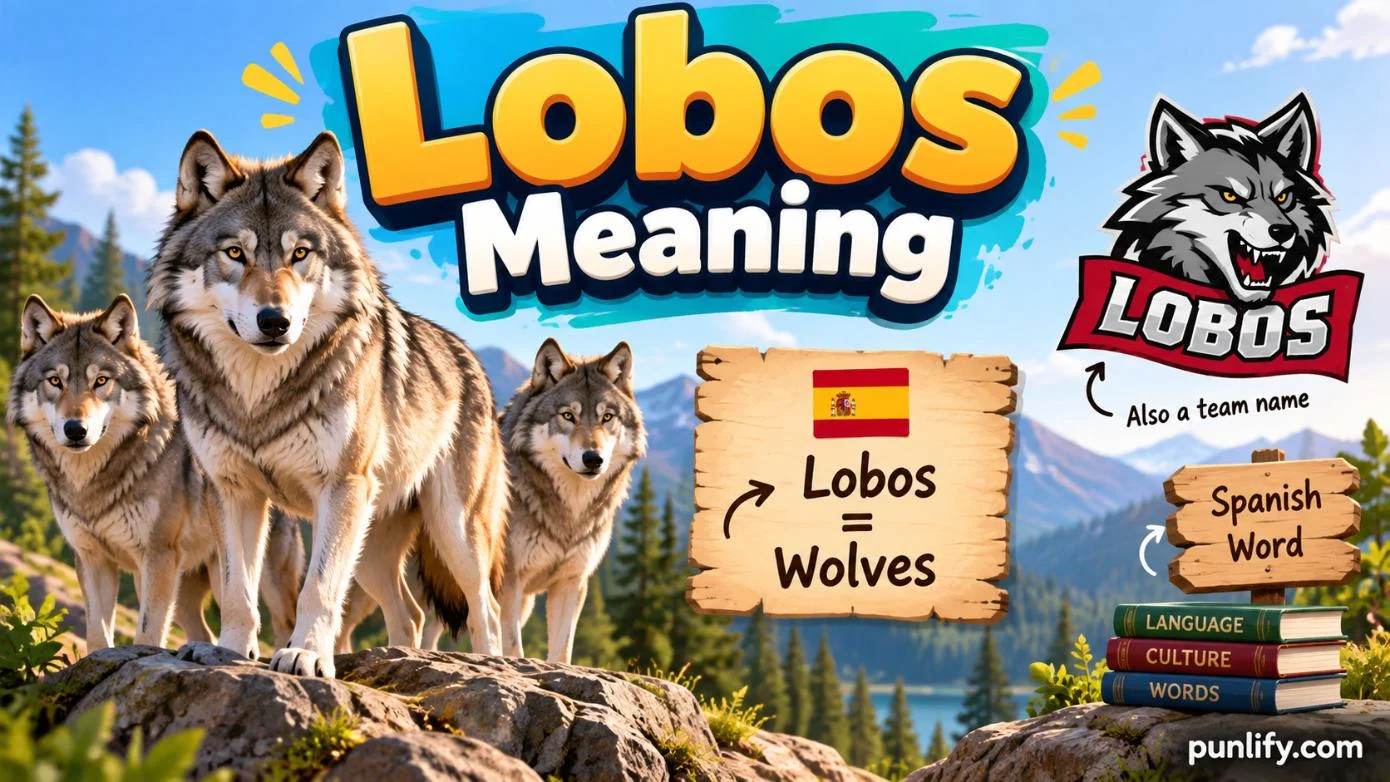
Lobos Meaning: The Complete Guide to Origin, Symbolism 🐺
Have you ever heard the word “lobos” and felt an odd little shiver run down your spine? Maybe you saw it tattooed on someone’s arm, spotted it as a sports team name, or heard it whispered in a Spanish-language song and thought, “What does that actually mean?” 🤔 You’re definitely not alone. Thousands of people search for the lobos meaning every single month, and honestly, it’s one of those words that sounds mysterious, powerful, and a little bit wild — because it is.
In this deep-dive guide, we’re going to unpack everything about lobos meaning — from its Spanish and Latin roots, to its use as a surname, a brand name, a sports mascot, and even a symbol of freedom and loyalty in pop culture. Whether you stumbled here out of pure curiosity or you’re thinking about naming your business, your pet, or even your child something connected to lobos, this article will give you the full, honest, expert-level picture. 🐾
Let’s dig in together.
🐺 What Does “Lobos” Actually Mean?
At its simplest, lobos is the plural form of the Spanish word “lobo,” which translates directly to “wolves” in English. So when someone says “lobos,” they are literally talking about more than one wolf. That’s the short answer. But like most words that travel across languages and cultures, the lobos meaning goes far deeper than a simple dictionary definition.
The word carries connotations of strength, pack loyalty, survival instinct, and untamed freedom. It’s not just an animal name — it’s practically a symbol. Think about it: wolves live in tight-knit family units, hunt strategically, protect their young fiercely, and roam wide, open landscapes. That entire personality gets bundled into the single word lobos whenever it’s used symbolically.
“A single wolf can be hunted down, but a pack of lobos moves as one heartbeat.” — a popular Spanish proverb often shared in discussions about loyalty and unity.
📜 The Origin and Etymology Behind Lobos
To really understand the lobos meaning, we need to travel back roughly two thousand years. The word originates from the Latin term “lupus,” which also meant “wolf.” As Latin slowly evolved into the Romance languages (Spanish, Portuguese, Italian, French, and others), pronunciation and spelling shifted dramatically over centuries.
In Spanish specifically, the hard “p” sound in lupus softened into a “b” sound, and the ending “-us” was dropped. That’s how we eventually landed on the modern Spanish singular “lobo” and its plural, lobos. Portuguese and Galician followed a nearly identical path, which is why you’ll see the word “lobo” appear across multiple Iberian languages with the same core meaning.
🧬 A Quick Look at the Word’s Family Tree
| Language | Word for Wolf | Root Origin |
|---|---|---|
| Latin | Lupus | Proto-Italic *lukʷos |
| Spanish | Lobo (singular) / Lobos (plural) | Latin lupus |
| Portuguese | Lobo / Lobos | Latin lupus |
| Galician | Lobo / Lobos | Latin lupus |
| English | Wolf / Wolves | Germanic root (separate branch) |
Interestingly, English “wolf” comes from a completely different linguistic branch (Germanic), while lobos traveled the Latin-Romance path. That’s exactly why the two words sound so different, even though they mean the exact same thing. Fun fact for your next trivia night! 🎉
🌎 Where You’ll Hear “Lobos” Used Today
Once you start noticing the word lobos, you’ll realize it’s absolutely everywhere. It shows up in geography, sports, entertainment, business branding, and even personal names. Let’s break down the most common real-world contexts where the lobos meaning comes into play.
🏔️ 1. Place Names
Many towns, islands, and natural landmarks across Spanish-speaking regions carry the name Lobos, usually because wolves historically roamed those areas or because the terrain resembled a wolf’s territory. A well-known example is the Lobos Islands, a group of small islands that have appeared in historical maritime records for centuries. Wherever explorers or settlers noticed frequent wolf activity, the name stuck — and it stayed part of the local identity for generations.
🐺 2. Surnames and Family Names
The surname Lobos (and its close cousin Lobo) is common across Spain, Portugal, and Latin America. Historically, surnames like this were either:
- Toponymic — meaning the family lived near a place literally called “Lobos” or a wolf-populated region
- Occupational or descriptive — meaning an ancestor may have earned the nickname for being fierce, clever, or stealthy, like a wolf
You’ll also find related surnames like Villalobos, which literally translates to “town of wolves,” and Lobato, meaning “wolf cub.” These variations all trace back to the same proud lobos family tree.
⚽ 3. Sports Teams and Mascots
If you follow soccer, basketball, or college athletics, you’ve almost certainly seen the word Lobos plastered across a jersey. Countless teams across Latin America, Spain, and the United States use Lobos as their mascot name because it instantly communicates aggression, teamwork, and pack mentality — exactly the traits a winning team wants to embody. When fans chant “Lobos!” in a stadium, they’re channeling that same untamed energy the word has carried for centuries.
🎬 4. Entertainment, Music, and Pop Culture
The word lobos shows up frequently in music, film titles, and band names. Musicians often gravitate toward it because of its punchy sound and the raw imagery it evokes. It feels bold, rebellious, and a little dangerous — everything a great stage name or album title needs. If you’ve ever browsed music streaming platforms, chances are you’ve come across at least one artist or group using lobos somewhere in their branding.
🧠 The Symbolic Meaning of Lobos in Culture
Beyond the literal translation, the lobos meaning carries rich symbolic weight across many cultures. Wolves have fascinated humans since prehistoric times, appearing in folklore, mythology, and spiritual traditions across the globe. Here’s what lobos tends to symbolize:
- 🐾 Loyalty — Wolves mate for life and protect their pack fiercely, making “lobos” a popular symbol for unbreakable bonds.
- 🌙 Instinct and Intuition — In many indigenous and folk traditions, wolves represent trusting your gut and reading situations before acting.
- 🔥 Independence — The idea of the “lone wolf” (lobo solitario) has become shorthand worldwide for someone who thrives outside the crowd.
- 🛡️ Protection — Wolf imagery is often used in family crests and tattoos to represent guarding loved ones.
- ⚡ Strength in Numbers — The plural form itself, lobos, emphasizes the power of the pack rather than the individual.
This is exactly why the plural word carries slightly different emotional weight than the singular “lobo.” Saying lobos conjures an image of a coordinated group — a family, a team, a tribe — moving together with shared purpose.
🏛️ Lobos in Historical Documents and Colonial Records
Here’s a lesser-known piece of history connected to the lobos meaning. During the colonial era in parts of Spanish America, the term “lobo” was used within an official social classification system that categorized people by mixed ancestry. This system, now widely criticized and studied by historians as an outdated and problematic practice, shows just how deeply embedded the word “lobo” became in everyday administrative language centuries ago.
While this historical usage is important for understanding the word’s full linguistic journey, it’s worth noting that modern usage of lobos has moved entirely away from that context. Today, the word is almost exclusively associated with the animal, its symbolism, and its use in names and branding — not with that outdated historical classification.
💼 Why Businesses and Brands Love the Word Lobos
Marketers and entrepreneurs are drawn to lobos for very practical reasons. Here’s why it works so well as a brand name:
| Branding Factor | Why “Lobos” Works |
|---|---|
| Memorability | Short, punchy, and easy to pronounce in multiple languages |
| Emotional Association | Instantly evokes strength, freedom, and teamwork |
| Visual Branding | Wolf imagery is bold and works beautifully in logos |
| Cross-Market Appeal | Recognized and understood across Spanish and Portuguese-speaking markets |
Restaurants, breweries, clothing lines, gyms, and even tech startups have used lobos in their branding for exactly these reasons. If you’re building a brand yourself and considering the name, you’re tapping into centuries of built-in symbolism — that’s a serious head start. 💪
👶 Is “Lobos” Used as a First Name?
While lobos is far more common as a surname or brand term, some parents in Spanish-speaking communities have used related forms — like Lobo or Lope (an old Basque and Spanish given name meaning “wolf”) — as first names for their children. The appeal is obvious: giving a child a name rooted in strength and resilience feels meaningful to many families. If you’re considering a wolf-inspired name, it helps to know the full history and pronunciation before making it official.
🗣️ How to Pronounce “Lobos” Correctly
Pronunciation is simpler than it looks. In Spanish, lobos is pronounced “LOH-bohs.” Each syllable is crisp and clear:
- LOH — like the “lo” in “low”
- bohs — like “boes,” rhyming with “toes” but starting with a “b”
Unlike English, Spanish vowels are consistent and don’t shift sound depending on context, which actually makes lobos one of the easier Spanish words for English speakers to pronounce confidently on the first try. 🎤
🔍 Common Misunderstandings About the Word Lobos
Because lobos sounds similar to a few other words, people sometimes mix things up. Let’s clear up the confusion:
- Lobos vs. “Globos” — “Globos” means “balloons” in Spanish. Very different meaning, easy to mishear!
- Lobos vs. “Lobbies” — Unrelated. “Lobby” comes from a completely different linguistic root tied to English and Medieval Latin architecture terms.
- Lobos vs. “Lupus” (the illness) — Interestingly, the autoimmune disease lupus actually does share the same Latin root as lobos! Historically, some skin conditions associated with the disease were thought to resemble wolf bites, which is how the medical term got its name.
That last connection genuinely surprises most people — it’s a perfect example of how deep and far-reaching the lobos meaning and its Latin origin really stretch across completely unrelated fields.
🌟 Lobos Meaning in Modern Slang and Everyday Speech
In casual, everyday Spanish conversation, lobos can also pop up in idiomatic expressions. For example, the phrase “vestido de cordero pero es un lobo” (dressed like a lamb but is a wolf) is used to describe someone who appears harmless but is actually cunning or dangerous — very similar to the English idiom “a wolf in sheep’s clothing.” Expressions like this show just how naturally wolf imagery, and by extension the word lobos, has woven itself into daily language and storytelling.
📊 Quick Summary Table: Lobos Meaning at a Glance
| Aspect | Details |
|---|---|
| Literal Meaning | Plural of “lobo” — wolves |
| Language of Origin | Spanish (from Latin “lupus”) |
| Common Uses | Surnames, place names, sports mascots, brand names |
| Symbolism | Loyalty, strength, instinct, independence, teamwork |
| Pronunciation | LOH-bohs |
Whenever you need a fast refresher on the lobos meaning, this table is basically your cheat sheet. 📌
🌕 Lobos in Mythology and Folklore Around the World
Wolves haven’t just influenced language — they’ve shaped mythology across nearly every continent, and the lobos concept fits neatly into this much bigger global story. In Norse mythology, the wolf Fenrir was a terrifying, world-shaking force feared even by the gods. In Roman legend, a she-wolf famously nursed and raised the twin founders of Rome, Romulus and Remus, turning the wolf into a symbol of nurturing strength rather than pure danger. Meanwhile, across many Indigenous cultures in North America, wolves are honored as teachers, guides, and spiritual protectors, closely tied to family and community values.
What’s fascinating is that Spanish-speaking cultures inherited much of this same duality. On one hand, lobos can represent danger and cunning, as seen in classic fairy tales translated into Spanish, like “Caperucita Roja” (Little Red Riding Hood), where the lobo is the classic villain. On the other hand, lobos also represents protection, family bonds, and courage in more modern storytelling, sports culture, and branding. This tug-of-war between “feared predator” and “noble protector” is part of what makes the word so emotionally rich and endlessly reusable.
📚 Lobos in Literature and Storytelling
Writers have long understood the emotional punch that comes from using lobos in a title or as a central symbol. A pack of wolves moving silently through a forest instantly creates tension, mystery, and atmosphere without needing much extra description. Spanish-language novels, poems, and short stories frequently lean on wolf imagery to represent themes like:
- 🌲 Isolation and survival in harsh, unforgiving environments
- 👨👩👧👦 Family loyalty when characters band together against adversity
- ⚔️ Inner conflict, often symbolizing the “wild” or untamed side of a character’s personality
Even outside literature, you’ll notice screenwriters and game designers reaching for the same imagery. Video games, in particular, love using lobos or wolf-pack mechanics to represent factions, guilds, or clans — groups of players who hunt, strategize, and win together, just like a real wolf pack would in the wild.
🌍 Regional Differences in How Lobos Is Used
Although the core lobos meaning stays consistent across the Spanish-speaking world, the way people use the word can shift slightly depending on the region. Here’s a quick regional breakdown:
| Region | Common Usage of “Lobos” |
|---|---|
| Mexico | Popular in sports team names and as a common surname element |
| Spain | Frequently tied to historic place names and noble family surnames |
| Chile & Argentina | Common surname (Lobos), especially in athletics and public figures |
| United States (Southwest) | Borrowed into English via “lobo,” referring specifically to the native gray wolf |
This regional flexibility is actually part of why lobos travels so well internationally. It doesn’t feel locked into one single country or culture — it feels borrowed, shared, and beloved almost everywhere Spanish (or Spanish-influenced English) is spoken.
🐕 Lobos vs. Domestic Dogs: Understanding the Real Animal
Since the word literally means “wolves,” it helps to understand a bit about the actual animal behind the symbolism. Real wolves are highly social, intelligent, and family-oriented animals that live in structured packs, usually led by a breeding pair. Unlike the common myth of a chaotic, blood-thirsty predator, wolf packs actually rely on cooperation, communication, and clearly defined roles to survive.
This is exactly why using lobos to describe a team, a family, or a business feels so appropriate. It’s not just about ferocity — it’s about structure, strategy, and unity. A group of lobos isn’t just tough; it’s smart, coordinated, and deeply loyal to its members. That nuance is often lost when people only think of wolves as “scary,” but understanding it gives you a much richer appreciation for why the word carries such positive branding power today.
🐺 Choosing a Lobos-Themed Name: Practical Tips
If this article has inspired you to actually use lobos somewhere — for a pet, a business, a sports team, or even a piece of art — here are a few practical tips to help you use it well:
- Pair it with imagery thoughtfully — A howling wolf silhouette pairs beautifully with the word lobos in logo design.
- Consider singular vs. plural — “Lobo” (singular) suggests one strong individual, while lobos (plural) emphasizes teamwork and community.
- Check for regional connotations — If you’re launching a brand internationally, research whether “lobos” carries any local team rivalries or existing associations.
- Keep pronunciation in mind — Since it’s pronounced “LOH-bohs,” make sure it flows naturally with any additional branding words you plan to pair it with.
These small details make a big difference, especially if you’re building something that needs to feel authentic rather than like a random word grabbed off a translation app.
🐾 Why This Word Continues to Resonate With People
At the end of the day, words survive and spread because they capture something humans deeply relate to. Lobos has stuck around across languages, centuries, and continents because the wolf itself is such a powerful animal metaphor. We admire their loyalty. We respect their independence. We fear their power, yet we’re drawn to their intelligence. Every time someone chooses the word lobos for a team name, a family crest, or a piece of art, they’re tapping into thousands of years of shared human fascination with these animals
🎨 Visual Design Ideas Inspired by Wolf Symbolism
If you’re a designer, artist, or small business owner exploring this theme visually, there’s a wide creative range to draw from. Some go bold and graphic, using sharp geometric lines to suggest speed and power. Others lean into a softer, more illustrative style, showing a family unit resting together to emphasize warmth and togetherness rather than aggression. Here are a few creative directions worth considering:
- 🖤 Minimalist line art — A single continuous line forming a howling silhouette against a full moon
- 🏔️ Nature-inspired scenes — Mountain ranges, forests, or snowy landscapes paired with a pack in motion
- 🛡️ Heraldic or crest-style — Bold shields and banners for sports teams, family crests, or fraternal organizations
- ✨ Modern gradient branding — Sleek, tech-forward logos for startups wanting a strength-driven identity
Each of these styles tells a slightly different emotional story, even though they all pull from the same core imagery. The trick is matching the visual tone to the actual message you want your audience to feel — protective and grounded, or fierce and unstoppable.
🧭 A Short Timeline of How the Term Evolved
To wrap up the historical picture, here’s a simplified timeline showing how this single concept traveled across thousands of years and ended up as a beloved, widely recognized term today:
| Era | Development |
|---|---|
| Ancient Rome | Latin “lupus” used broadly to describe the wolf and later associated with courage and Roman founding myths |
| Early Medieval Iberia | Latin gradually shifts into early Spanish and Portuguese, softening into “lobo” |
| Medieval & Colonial Period | Surnames, place names, and family identities form around wolf-related terminology |
| 19th Century | Term crosses into American English via the U.S. Southwest, describing the native gray wolf |
| Modern Era | Widely adopted across sports, branding, entertainment, and personal identity worldwide |
Seeing it laid out this way really highlights just how much history is packed into a term most people only think about for a few seconds before moving on with their day.
💬 What People Often Say When They Discover This Word’s Depth
It’s genuinely common for people to feel a small sense of delight once they realize how much history and symbolism hides behind such a short, simple-sounding term. Language learners in particular often mention that discovering word origins like this one makes vocabulary stick far better than rote memorization ever could. Once you connect a word to a story — Roman founders, native wildlife, family crests, championship teams — it becomes almost impossible to forget.
That emotional connection is really the whole point of language, isn’t it? Words aren’t just tools for communication; they’re tiny time capsules carrying centuries of human experience, migration, fear, pride, and identity, all packed into a handful of letters and a couple of syllables.
❓ FAQs:
1. What does “lobos” mean in English?
Lobos means “wolves” in English. It’s the plural form of the Spanish word “lobo,” which means “wolf.”
2. Is “lobos” a name or just a word?
It’s both! Lobos functions as a common noun meaning “wolves,” but it’s also widely used as a surname, a sports team name, and a brand name across Spanish-speaking countries and beyond.
3. Where does the word “lobos” come from?
The word traces back to the Latin term “lupus,” meaning wolf. Over centuries, Latin evolved into Spanish, softening “lupus” into “lobo,” with lobos as its natural plural form.
4. Why do sports teams use “Lobos” as a mascot name?
Teams choose lobos because wolves symbolize teamwork, strength, and pack loyalty — qualities every competitive team wants to represent on and off the field.
5. Is “lobos” related to the medical term “lupus”?
Yes, surprisingly! Both words share the same Latin root, “lupus,” which is where the connection between lobos and the autoimmune condition lupus originally comes from.
🧩 Putting It All Together: A Word Bigger Than Its Definition
By now, it should be pretty clear that a single dictionary definition could never fully capture what this term represents. It functions as a noun, a surname, a place name, a mascot, a brand identity, and a cultural symbol, all at once. Few words manage to stretch across that many categories while still feeling completely natural in each one. That versatility is rare, and it’s a big part of why the term keeps showing up in new contexts decade after decade.
It also helps that the underlying animal itself is so universally respected. Few creatures balance danger and devotion, independence and loyalty, quite the way wolves do. Borrowing that duality for a name, a team, or a brand instantly hands you a built-in story — one that took nature millions of years to write and humans thousands of years to translate into language.
🎯 Final Thoughts:
So, what’s the real takeaway here? The lobos meaning is so much richer than a simple translation. Yes, at its core, it means “wolves.” But layered on top of that literal definition is centuries of history, migration, symbolism, and cultural pride. From ancient Latin roots to modern sports jerseys, from quiet Spanish villages named after wolf packs to bold brand logos on city streets, the word lobos has proven remarkably resilient and endlessly adaptable.
Whether you came here out of simple curiosity, for a naming project, or because you’re fascinated by language and etymology, we hope this guide gave you a genuinely complete, trustworthy picture of everything lobos represents.
👉 Loved this deep dive? Explore more fascinating word origin guides and cultural symbolism articles on our blog to keep feeding your curiosity!

Ethan Parker is a dedicated content writer at Punlify.com, passionate about making language simple, clear, and easy to understand. He creates engaging, accurate, and reader-friendly content that helps people quickly understand modern words, phrases, slang, and everyday expressions.






One Comment