
Gracious Meaning: What It Means & Why It Still Matters Today
Have you ever met someone who made you feel instantly comfortable, respected, and valued — without even trying hard? That warm, kind energy has a name, and it’s called being gracious. If you’ve ever searched for the gracious meaning because you heard the word in a movie, read it in a book, or got called “gracious” by someone and wondered if it was a compliment (spoiler: it almost always is 😊), you’re in exactly the right place.
In this guide, we’ll break down the real gracious meaning, where the word comes from, how to use it correctly, and why graciousness is a quality worth building in your own life. No fluff, no confusing dictionary jargon — just simple, human explanations with real examples. Let’s dive in! 🚀
What Is the Gracious Meaning? (Quick Definition) 📖
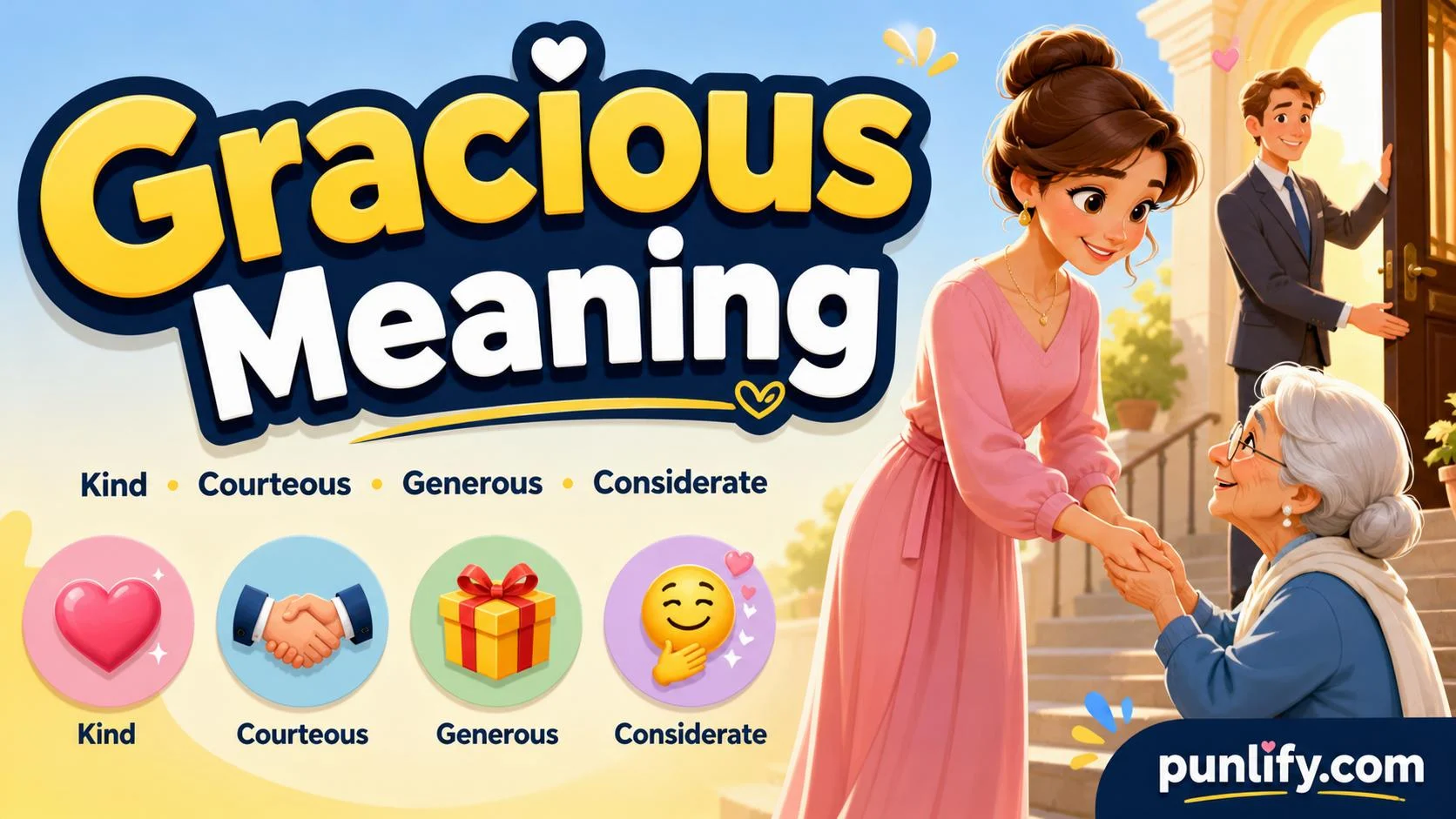
At its core, gracious means being kind, polite, warm, and courteous — especially in a way that feels genuine and generous, not forced. A gracious person treats others with respect, even in difficult or awkward situations. They make people feel welcome, valued, and at ease.
Simple definition: Gracious (adjective) showing kindness, courtesy, and warmth toward others, especially in a polite and generous way.
Think about the last time someone lost a competition but still smiled, congratulated the winner, and shook their hand warmly. That’s graciousness in action. It’s not about being perfect it’s about being kind under pressure.
The Origin of the Word “Gracious” 🏛️
Understanding where a word comes from often makes its meaning click instantly. The word gracious has a rich history rooted in the idea of “grace.”
- Latin root: It comes from the Latin word gratiosus, meaning “pleasing” or “favored.”
- Old French influence: The word passed through Old French as gracios, keeping the sense of charm and favor.
- Connection to “grace”: Both words share the same root, gratia, which relates to kindness, goodwill, and elegance.
- Modern English: Over centuries, “gracious” evolved to describe someone who treats others with warmth, courtesy, and generosity.
So when someone calls you “gracious,” they’re essentially saying you carry that same energy of grace — calm, kind, and considerate. Pretty beautiful, right? ✨
Gracious Meaning in Different Contexts 🔍
One reason people get confused about the gracious meaning is that the word shifts slightly depending on how it’s used. Let’s break it down.
Gracious as a Personality Trait
This is the most common usage. It describes someone who is naturally polite, warm, and considerate in everyday interactions — a gracious host, a gracious neighbor, or a gracious friend.
Gracious in Formal or Royal Contexts
You’ll often hear phrases like “by gracious permission” or “gracious majesty.” Here, the word carries a slightly formal, almost regal tone — implying kindness combined with authority or generosity from someone in a position of power.
Gracious as an Exclamation
Ever heard someone say “Good gracious!”? This is an older expression of mild surprise or shock. It doesn’t relate to kindness at all — it’s just a polite way of reacting to something unexpected, without using stronger language.
| Context | Example Sentence | Meaning |
|---|---|---|
| Personality trait | She was gracious even after losing the match. | Kind and dignified under pressure |
| Formal/royal use | By her gracious majesty’s permission. | Kindly generous, dignified |
| Exclamation | “Good gracious, I forgot my keys!” | Mild surprise (no relation to kindness) |
| Hospitality | Their home had a gracious atmosphere. | Elegant, welcoming, comfortable |
Gracious vs Graceful vs Grateful: Don’t Mix Them Up! ⚠️
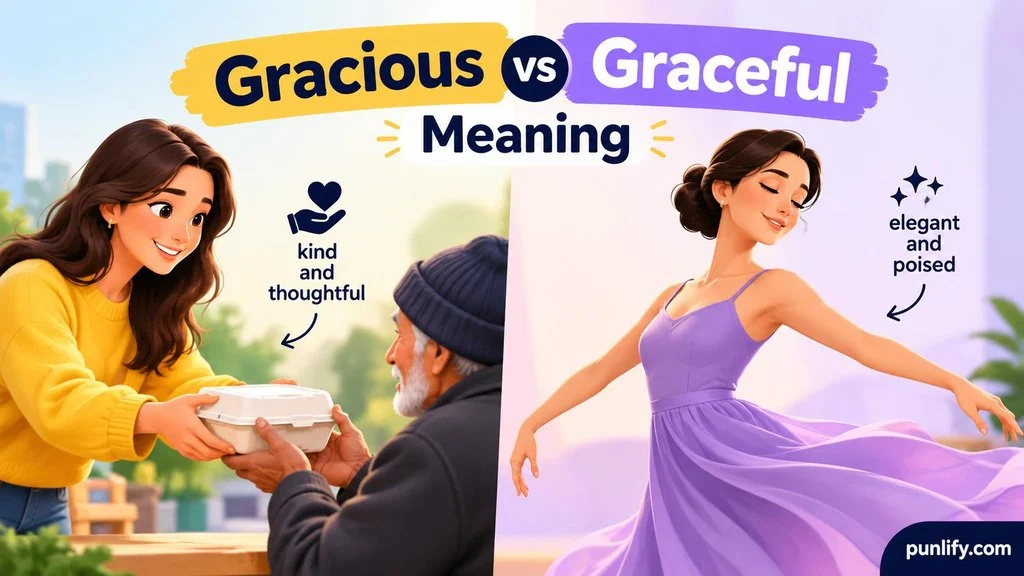
This is one of the biggest mix-ups people make. These three words look similar but mean completely different things.
- Gracious — kind, polite, warm toward others.
- Graceful — moving or behaving with elegance and physical beauty (like a dancer).
- Grateful — feeling or showing thankfulness and appreciation.
Quick trick to remember: Grateful has “grate” like “great thanks.” Graceful relates to physical grace and movement. Gracious relates to how you treat other people. Once you separate these three, you’ll never confuse them again! 🎯
Synonyms and Antonyms of Gracious 🔄
Expanding your vocabulary around this word helps you use it more naturally in writing and speech.
| Synonyms (Similar Meaning) | Antonyms (Opposite Meaning) |
|---|---|
| Courteous | Rude |
| Kind | Harsh |
| Polite | Discourteous |
| Warm-hearted | Cold |
| Considerate | Inconsiderate |
| Charming | Abrupt |
| Hospitable | Unwelcoming |
Real-Life Examples of Graciousness in Action 🌟
Definitions are helpful, but real examples make the gracious meaning truly click. Here are everyday situations where graciousness shines through:
- 🏆 A team captain congratulating the opposing team after a tough loss.
- 🏡 A host making an uninvited guest feel just as welcome as everyone else.
- 💬 Someone calmly thanking a critic for feedback instead of getting defensive.
- 🎁 A person graciously accepting a gift they didn’t love, without showing disappointment.
- 🤝 A boss thanking an employee publicly for a mistake that was actually corrected quietly.
Notice a pattern? Graciousness usually shows up most clearly during uncomfortable or imperfect moments — not just when everything is going well. That’s what makes it such a respected quality.
Why Being Gracious Matters in Daily Life 💛
In a world that often rewards being loud, competitive, or defensive, choosing graciousness might feel old-fashioned. But it’s actually a superpower. Here’s why:
It Builds Trust Instantly
People naturally trust those who treat them with warmth and respect, especially strangers or new acquaintances.
It Strengthens Relationships
Gracious people are easier to be around. Friends, family, and coworkers feel safe and appreciated near them.
It Improves Leadership
Great leaders are almost always described as gracious — they handle mistakes, criticism, and pressure with calm dignity instead of anger.
It Reduces Conflict
A gracious response to an argument (staying calm, listening, not attacking) often de-escalates tension immediately.
How to Become a More Gracious Person (Practical Tips) 🌱
The good news? Graciousness isn’t a personality you’re born with — it’s a habit you can build. Here’s how:
- Pause before reacting. Give yourself a second before responding, especially when upset.
- Say thank you often — and mean it, even for small things.
- Give people the benefit of the doubt. Assume good intentions first.
- Compliment genuinely. Notice what others do well, and say it out loud.
- Accept criticism calmly. Respond with curiosity instead of defensiveness.
- Be a gracious loser and winner. Handle both outcomes with equal humility.
“Graciousness is not about never feeling frustration — it’s about choosing kindness anyway.”
Gracious Meaning in Literature and Culture 📚
The word “gracious” has appeared for centuries in literature, speeches, and religious texts, almost always tied to themes of mercy, kindness, and dignity. Writers often use “gracious” to describe characters who remain calm, kind, and composed even in hardship — a trait that instantly signals moral strength to the reader.
In many cultures, hospitality itself is described as “gracious” — welcoming guests with warmth, generosity, and respect, regardless of circumstances. This cultural thread shows just how deeply the idea of kindness-in-action is woven into the word’s meaning.
Common Phrases Using “Gracious” 🗣️
| Phrase | Meaning |
|---|---|
| Gracious host | Someone who welcomes guests warmly and generously |
| Gracious living | An elegant, comfortable, refined lifestyle |
| Good gracious! | An exclamation of mild surprise |
| Gracious in defeat | Handling loss with dignity and kindness |
| By your gracious leave | A formal, polite way of asking permission |
Gracious Meaning: Quick Recap Table 🧾
| Aspect | Details |
|---|---|
| Word | Gracious |
| Part of Speech | Adjective |
| Simple Meaning | Kind, polite, and warm toward others |
| Origin | Latin gratiosus → Old French gracios |
| Common Use | Describing kind, courteous behavior or hospitality |
| Related Words | Grace, Graceful, Gratitude |
Gracious meaning in english
Gracious means kind, polite, courteous, and pleasant in the way someone treats other people.
The word can describe a person who behaves warmly and respectfully, even in difficult situations.
For example, a gracious host makes guests feel welcome and comfortable.
Gracious can also describe accepting something politely, such as a compliment, gift, or apology.
In some contexts, it means showing elegance, generosity, or good manners.
A simple example is, “She was gracious enough to thank everyone for their help.”
Gracious Spanish
In Spanish, gracious is commonly translated as “amable,” “cortés,” or “gracioso,” depending on the context.
When gracious describes someone who is kind and polite, amable or cortés is usually more appropriate.
If the word refers to something charming or pleasing, another Spanish translation may fit better.
The exact translation therefore depends on whether gracious describes a person’s behavior, attitude, or appearance.
For example, “a gracious person” can be expressed as “una persona amable” in Spanish.
It is worth checking the surrounding sentence because one English word can have several natural Spanish equivalents.
Gracious meaning thank you
“Gracious” can appear in expressions connected with thanking someone, but it does not itself simply mean “thank you.”
A person may say “gracious” as part of the expression “much obliged,” which carries a polite sense of gratitude.
The phrase “gracious thanks” can also refer to sincere or courteous appreciation.
In older or more formal English, gracious language is often associated with showing gratitude and good manners.
If someone says “Thank you,” responding graciously means accepting or returning the kindness in a polite way.
So, when searching for the gracious meaning thank you, the key idea is courtesy and appreciation rather than a direct translation of “thank you.”
Gracious meaning french

In French, gracious can have different translations depending on the intended meaning.
For a person who is kind and courteous, words such as “gracieux” or “aimable” may be appropriate depending on the sentence.
“Gracieux” can also describe something elegant, graceful, or pleasing in appearance or movement.
For example, “une personne aimable” means a kind or pleasant person.
The English word gracious and the French word gracieux are related in form, but they do not always match perfectly in everyday usage.
The surrounding context is therefore important when choosing the most natural French equivalent.
Gracious meaning synonyms
Common synonyms for gracious include kind, courteous, polite, considerate, generous, warm, and welcoming.
The best synonym depends on which sense of gracious is being used.
For example, “courteous” works well when gracious refers to polite behavior toward others.
“Generous” is a better choice when the word describes someone willing to give or forgive freely.
“Elegant” or “graceful” may fit when gracious describes someone’s manner, movement, or style.
These related words share the general idea of pleasant and admirable behavior, but each carries its own shade of meaning.
Gracious meaning in farsi
The gracious meaning in Farsi depends on the context in which the English word is used.
When gracious means kind or courteous, it can be expressed with Persian words such as مهربان (mehrabān) or مودب (modab).
When it describes elegance or gracefulness, a different Persian expression may be more suitable.
For example, a gracious person may be described as someone who treats others with kindness and respect.
The translation should therefore reflect the particular sense rather than using one fixed Persian word every time.
In general, the idea behind gracious is positive behavior, politeness, warmth, or elegance.
Gracious meaning in Bible
In the Bible, gracious commonly carries the sense of showing favor, mercy, kindness, or undeserved generosity.
The word is often used when describing God’s character and His willingness to show compassion toward people.
In this religious context, gracious can suggest giving kindness or favor without it being earned.
The expression “gracious God” therefore emphasizes divine mercy, compassion, and loving favor.
The precise meaning can vary slightly depending on the Bible translation and the surrounding passage.
Unlike its everyday use for polite behavior, the biblical sense often has a deeper connection with mercy and divine favor.
Gracious meaning arabic
The gracious meaning in Arabic varies according to whether the word refers to kindness, politeness, generosity, or elegance.
For a kind or compassionate person, Arabic words such as كريم (karīm) or لطيف (laṭīf) may convey related ideas in suitable contexts.
When gracious means courteous or well-mannered, another Arabic expression may be more natural.
For example, describing someone as gracious can suggest that they treat others with respect, warmth, and generosity.
In religious contexts, gracious may also be connected with ideas of mercy, favor, and compassion.
Because Arabic has several words for these related qualities, the most accurate translation depends on the sentence and intended meaning.
FAQs:
Q1. What is the simplest gracious meaning?
In simple terms, gracious means being kind, polite, and warm toward other people, especially in a genuine and generous way.
Q2. Is “gracious” a compliment?
Yes! Being called gracious is almost always a compliment. It means people see you as kind, respectful, and pleasant to be around.
Q3. What is the difference between gracious and graceful?
Gracious relates to kindness toward people, while graceful relates to elegant physical movement or behavior, like a dancer’s poise.
Q4. Where does the word “gracious” come from?
It comes from the Latin word gratiosus, meaning “pleasing” or “favored,” later evolving through Old French into modern English.
Q5. Can “gracious” be used sarcastically?
Yes, in casual speech people sometimes say “how gracious of you” sarcastically to imply someone was actually rude or unhelpful — tone makes all the difference.
Final Thoughts:
At the end of the day, understanding the gracious meaning is about more than just vocabulary — it’s about recognizing a quality worth practicing. Graciousness shows up in small moments: a warm greeting, a calm response, a genuine thank you. And the best part? Anyone can build this trait, starting today, one kind interaction at a time. 💫
So the next time life gets messy, awkward, or frustrating, remember: you always have the choice to respond with grace.

Ethan Parker is a dedicated content writer at Punlify.com, passionate about making language simple, clear, and easy to understand. He creates engaging, accurate, and reader-friendly content that helps people quickly understand modern words, phrases, slang, and everyday expressions.






2 Comments